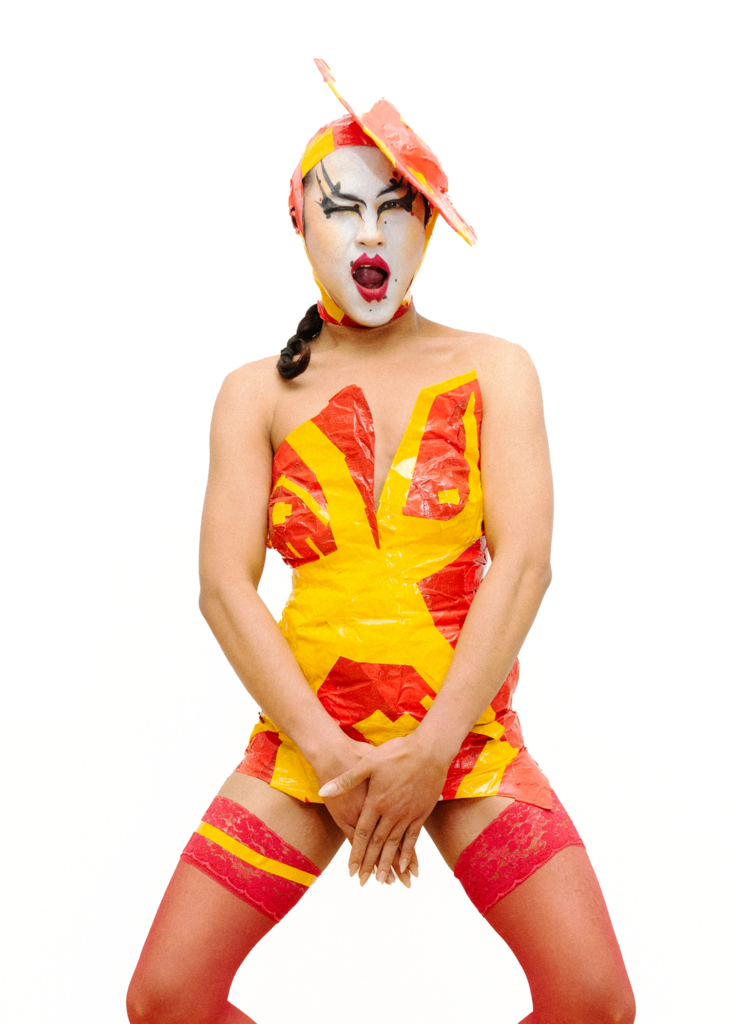
Zaym Zarif was born in 1997 in Malaysia, and is a visual artist and photographer based in Glasgow. Working primarily with self-portraiture, their practice explores identity, vulnerability, memory, and the fluid boundaries between truth and performance. Through staged portraits, role-play, and collaborative projects, Zaym investigates the intimate complexities of human relationships while challenging conventions of representation. They studied Fine Art Photography in Malaysia before completing a Master’s in Communication Design at The Glasgow School of Art, where they specialized in self-portraiture. Their work has been exhibited internationally in Malaysia, Indonesia, Singapore, Paris, Edinburgh, and Glasgow, with highlights including SHALS x Benefit Cosmetics (Singapore, 2021), IESA Gallery (Paris, 2021), Multilingual Matters (Glasgow, 2025), and Drag Me Up at Salt Space Gallery, Glasgow (2025) and often draws upon personal history, cultural heritage, and the act of becoming both subject and storyteller. By turning the lens inward, Zaym creates spaces of empathy and dialogue, inviting audiences to reflect on their own identities and perceptions.
See Zaym’s work as part of our conceptual photography open call, STAGED, curated by gallery intern Noa Ferder. The participating artists each examine how a still image can hold the tension of a performed moment, and carry liveness through composition, gesture, and construction. We create a space where photography is a site of performance, where the still is activated. We invite visitors to experience photographs that sit somewhere between rehearsal and outcome: the making of the image exists within the captured still, allowing the still to continue to perform in the act of being seen.
Thanks for being with us Zaym! Tell us how your artistic journey started.
My artistic journey began with self-portraiture, before the term ‘selfie’ even existed. Using my own body as the subject was initially practical, but it quickly became conceptual. It allowed me to experiment freely, to observe myself as both maker and material. Over time, self-representation became less about appearance and more about authorship, control, and visibility.
Can you walk us through your creative process?
Most of my works begin with a dream or an internal image. From there, I sit with the emotions that surface and ask myself how those feelings want to be translated visually. The process is intuitive but intentional. Many of my works function as a visual diary. They carry personal narratives, fragments of lived experience, and emotional states. I am not trying to explain everything to the viewer. The work invites interpretation, and I believe that those who recognise something within it are meant to.
What advice would you give to photographers who are just starting out their conceptual practice?
Copy. Steal. Experiment. Appropriation is not a failure, it is a starting point. By copying, stealing, and experimenting with the work of others, you begin to train your eye and understand your own instincts. Through repetition and exploration, you learn what resonates with you and what does not. From there, you move on, copy again, steal again, experiment again. Eventually, a pattern emerges, and that is where your voice begins to take shape.
Which artists inspire you? Are there non-artistic influences such as literature or music that impact your work?
I am inspired by artists who use self-representation as a political and emotional tool, including Cindy Sherman, Zanele Muholi, Gillian Wearing, Nadia Lee Cohen, Christopher Smith, and Grayson Perry. Their practices demonstrate how the body can function as a site of resistance, storytelling, and visibility. I am also influenced by contemporary photographers and performance artists such as Marina Abramović, whose work centres lived experience and challenges dominant narratives around identity, power, and belonging. Beyond visual art, personal experience itself is a constant influence. The work absorbs what I live, hear, and carry.
What challenges did you experience during the creation of your exhibited work and how did you overcome them?
A very practical one. I printed the photographs at the wrong size. They ended up significantly smaller than the frames, and I had limited time to resolve the issue.
Rather than correcting it, I leaned into it. I reworked the installation by playing with placement and intentional asymmetry. The photographs are not centred or straight, and viewers often question this choice. My response is simple: this project is not straight. The constraint became part of the narrative, reinforcing the themes of instability, queerness, and resistance to neat resolution.
Can you elaborate on the significance or symbolism of the chosen title for your work?
Drag Me Up speaks to collaboration, trust, and the desire to be seen. It reflects the act of allowing oneself to be lifted, supported, and witnessed by others. Drag, for me, is also a source of power. It creates a space where identity becomes fluid and self-authored. In drag, you can be anyone you want. There is freedom in that transformation, a temporary suspension of limitation. The title holds that tension between vulnerability and empowerment, between asking for support and claiming control. I would like to express my deepest gratitude to ZULAA, MASSEDUCTION, VANNA, XAVANNAH, and ELLA MENOPE for their collaboration on this project. Their contributions as makeup artists, stylists, and wig designers were integral to the realisation of Drag Me Up. This work would not exist in the same form without their creativity, trust, and generosity. The project is as much a collective effort as it is a personal one, and I am deeply thankful for the care and vision they brought into it.
STAGED runs at Six Foot Gallery until 24th February 2026. Connect with Zaym on Instagram or on their website.
Leave a Reply