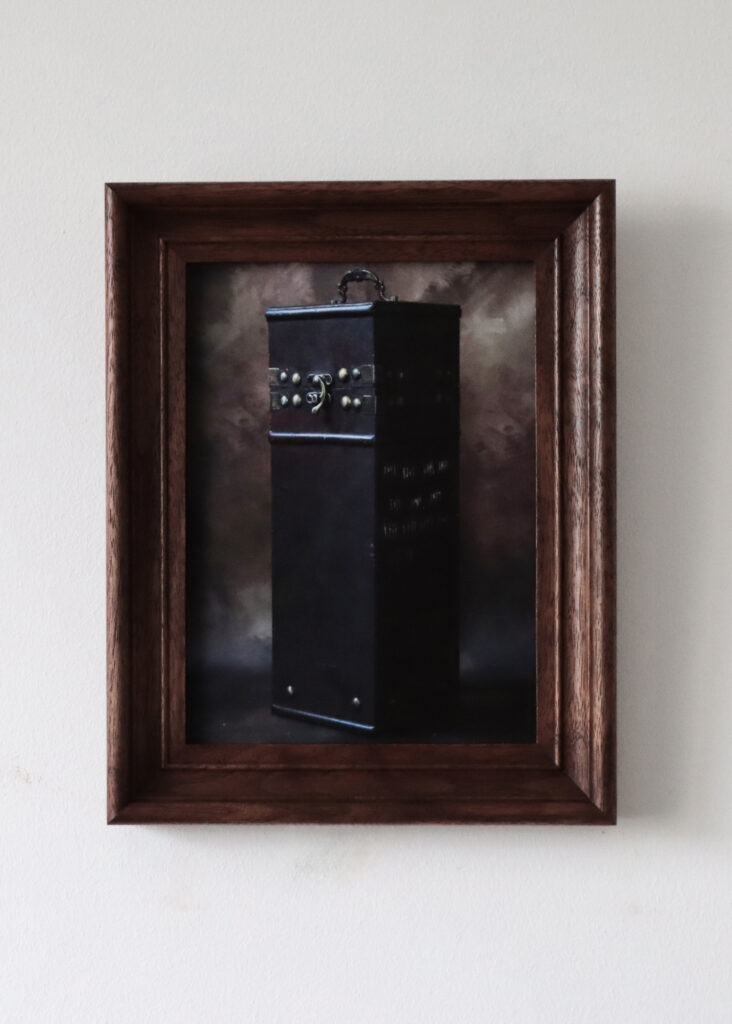
Yoanna Walden is a UK-based photographer (b. 2003) who, employing found objects, diy props, and her own body, stages images exploring themes of confinement, constraint and connection. Rooted in personal experience and shaped by an autodidactic approach, her practice interrogates systems of control and the social construction of madness. She engages with texts concerned with power and institutionalization, extracting words / phrases that inspire her and generate visual impulses which she then turns into photographs. Through her work she seeks to create a space in which historical experience, artistic response and contemporary reflection can co-exist. Yoanna left formal education at 15, and self-educated subsequently. She is now completing an MA in Creative Practice at Make Happen Institute, and has had work exhibited in the UK, China, and Greece.
See Yoanna’s work as part of our annual spring exhibition Offerings, exploring the ways that hope and creativity can take root in hostile environments. Inspired by queer histories of creating against all odds, and by the ways communities nurture possibility and make offerings for the future, Offerings showcases works that bring warmth, colour, and a sense of renewal, that soften the spaces they inhabit, or that suggest endurance or growth: no matter how harsh the winter, the flowers will bloom again.
Hi Yoanna! Can you walk us through your creative process?
My creative process generally starts from one of two points: a personal experience or memory, or through my research into literary and artistic sources. Much of my reading for my ongoing series The Lunatics’ Common Room is centred on authors who have experienced detention against their will in a mental hospital/asylum, and also on theorists who have critically examined the social construction of the categories of the sane and the mad and the systems of control and coercion that surround those identities. As I read, I take note of words and phrases that strike me, and these become the spark for the creation of an image. Once I have this image in mind, I proceed to realize it, often through the first step of assembling/modifying/creating props and then setting up the shot. I do plan quite carefully, but I am also open to the operations of chance and contingency. In particular, I use natural light in all my work, and the variability inherent in this of course influences the outcome in interesting ways.
How has your practice changed over time?
The visual language of my work has evolved quite a lot in the past year. As I take photographs, I observe what starts to emerge in them, noticing patterns and tendencies. If I like what I see, I continue to maintain or develop that element. I often notice these developments are linked to the themes of my work, without my initially having a conscious awareness of the connection. For example, I noted an increasing use of boxes and boxlike shapes and angles in my photographs, which correlates to the themes of constraint and confinement that I am exploring.
Which artists inspire you? Are there non-artistic influences such as literature or music that impact your work?
Antonin Artaud is an important influence on my work. I first encountered his writings after reading Foucault on madness and, with a shock of recognition, found him to be someone able to express feelings and states that I had previously thought inexpressible. He has become a touchstone for me. Other writers and artists such as John Thomas Perceval, Unica Zürn, Bessie Head, Osamu Dazai, Valérie Valère and Leonora Carrington have all provided inspiration, in particular for the works in my photo series The Lunatics’ Common Room, but also more broadly for me as an artist. Recently I learned a little about the Brazilian creative Stella do Patrocínio, who spent her whole life from the age of twenty one in a mental hospital. Her life and words became an important part of the anti-asylum movement in Brazil, and I plan to create some work inspired by her soon.
What emotions or reactions do you hope viewers experience when they see your artwork?
I hope that initially my work will intrigue and draw the viewer in. The works often foreground single objects, presented in a way which invites contemplation. Beyond that initial encounter, through my process of attempting to translate the lives of the mad into photographic images I hope to inspire others to view their voices as worthy of inclusion in serious artistic dialogue and worthy of being experienced without the lens of pathologization. When I provide accompanying text for my works, diagnoses are absent, encouraging the viewer to encounter the writers and artists who inspired the photographs as individuals and not, as is often the case, opportunities to peer into the insane mind.
What challenges did you experience during the creation of your work and how did you overcome them?
In the case of Engraving, my goal was to express the warping of the experience of time that occurs when one is deprived of one’s liberty in a hostile / indifferent environment. How does one represent this essentially immaterial experience in a material visual form? Here I decided to use the trope of the prisoner’s scratching of a line on the wall of their cell for each day that passes in an attempt to hold onto time itself as the basis for the image. The side of a box, with its connotations of locking away, was used as the wall. The image is also connected to the experiences of both Antonin Artaud and Osamu Dazai, both of whom used the walls of their hospital rooms as a canvas/page for artistic and written expression.
How do you know when a piece is complete?
As a photographer there are multiple points in the process of creating the work at which one assesses it – have I got the best shot / framing? Then there is the editing process: am I happy with the colour balance, the crop etc? Then finally how will the work be viewed – if printed, what process and what paper? What sort of frame or other presentation device will be used to display it? Only once I have taken the piece through each of these phases can I say that I have a complete work.
OFFERINGS runs at Six Foot Gallery until 21st April 2026. Connect with Yoanna on Instagram.
Leave a Reply