
Our current show, Ephemeral Chroma, brings together four artists whose work foregrounds colour as both a deeply personal expression and a shared, affective force. Having studied Fine Art and Design at Liverpool Hope University, Sophie Elsden, Desiree Skellern, Sophie Baskerville, and Roozbeh Rajaie now diverge across abstraction, landscape, and experimental approaches. Binding their practices together is a shared fascination with chroma as something unstable, relational, and profoundly human.
Born in Coventry and now based in Liverpool, Sophie Baskerville is a contemporary painter whose practice explores the tangible physicality of painting as an object, while also engaging with deeper sociological concepts. Through the use of familiar imagery placed in unfamiliar contexts, her work creates spaces for questioning and reimagining collective and personal narratives.
After moving to Liverpool in 2019, Sophie studied Fine Art at Liverpool Hope University, graduating in 2021 with First Class Honours. During her final year, she was awarded the Freelands Foundation Painting Prize, which enabled her to exhibit work in London. Since then, she has held a studio with Arena Studios in Liverpool’s Baltic Triangle, contributing to the city’s vibrant cultural scene while exhibiting in collaborative curatorial projects and group shows across Liverpool and Coventry.
In addition to her studio practice, Sophie completed a PGCE in Art and Design in 2023 and currently teaches secondary and A Level Art and Photography. Balancing education and practice, she continues to develop a distinctive body of work that reflects both material experimentation and sociological inquiry.
Thanks for being with us, Sophie! Let’s start out by asking: how do you overcome creative blocks?
I often work on multiple paintings simultaneously, typically five to ten at a time, moving between them as each evolves. This approach prevents overworking a single piece, keeps my practice fresh, and allows the works to develop their own “conversations” with each other. My paintings are unplanned; they unfold naturally as I work, and new challenges arise within the process, which keeps me engaged and prevents stagnation.
For starting points or inspiration, I maintain a collection of notes, phrases, observations, and photographs of everyday moments from discarded objects on the street to graffiti-covered doorways. I use these visual stimuli to experiment with collages, colors, shapes, and themes, which often become the jumping-off point for a new painting. This constant gathering of material ensures I always have ideas to draw from, even when the studio feels challenging.
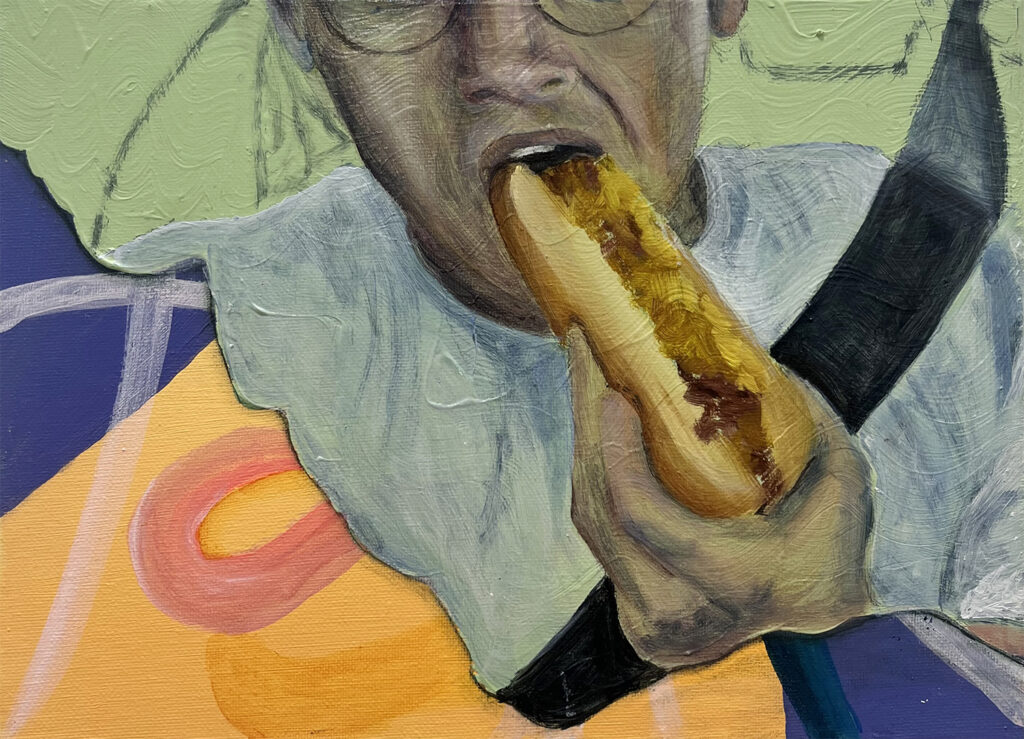
What emotions or reactions do you hope viewers experience when they see your artwork?
I don’t approach my work with a single prescribed reaction in mind. Instead, I aim to present visual information that viewers can interpret within their own contexts. Much of my imagery is recognisable, ranging from nostalgic references like old cartoons to everyday objects or food, but I often present it in ways that feel uncomfortable or unexpected. By taking things people might not typically notice, or might consider grotesque or crude, and juxtaposing them within a new context, the familiar becomes strange, prompting viewers to reconsider their associations.
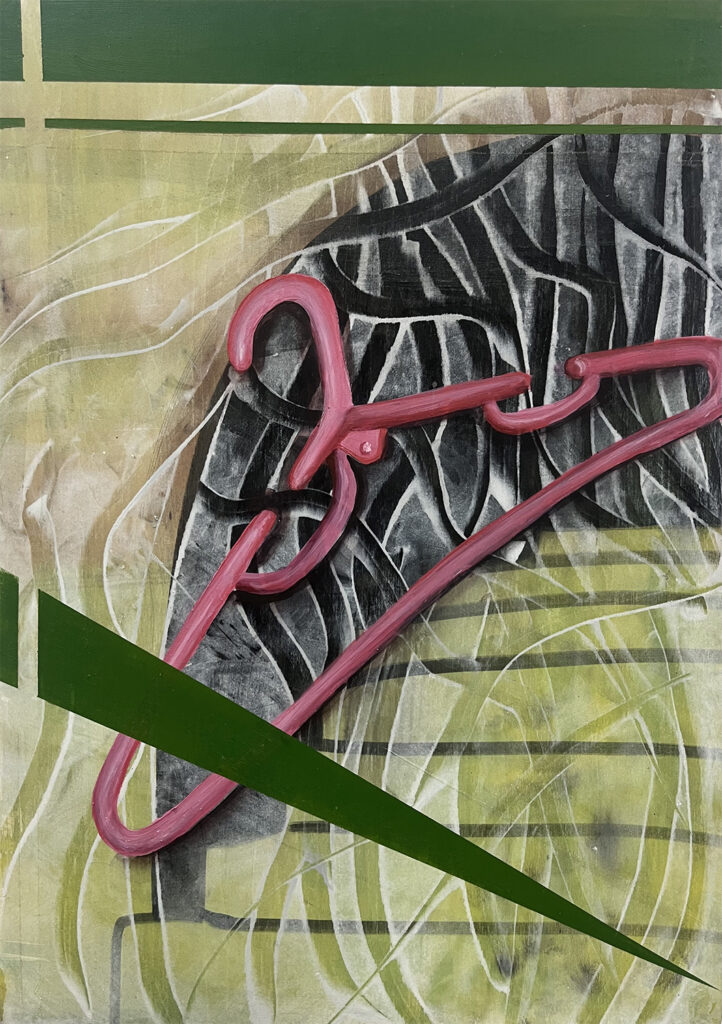
I also enjoy rewarding close observation. Small, hidden elements on the edges of the paintings invite viewers to engage more deeply, highlighting the work as a three-dimensional object while adding layers to its narrative. This is further explored through the surface of the painting itself, where different areas operate on different planes, creating a subtle tension between familiarity and fragmentation.
What advice would you give to artists who are just starting out?
As a teacher, this is a conversation I have often, and my advice is to separate yourself from what you feel ‘good at’. It’s easy to get caught up in perfecting technique, and while skill is important, focusing on it alone can limit the creative process. At the end of the day, you cannot compete with a camera, you need to engage with what makes your practice unique.
When developing my own work, if I noticed I had become overly obsessed with rendering a particular detail, I would often throw paint over it entirely. I genuinely believe that every artist has to fight with their work. If everything feels effortless, it usually means you’re too comfortable. Each piece should reach a stage where you feel frustrated, even ready to quit, before you push through and arrive at those moments of discovery and breakthrough. That struggle is essential to growth and creative reward.
Are there specific advantages or challenges associated with working in your chosen mediums? Have you experimented with other mediums or techniques?
I primarily work in acrylic and oil, often using Liquin with oils to achieve rapid drying and a high level of transparency. My process is fully immersive. I mix paint on my hands, hold brushes in both hands, and often end up covered in paint. My studio clothes carry the history of all the work I’ve made. I am drawn to the idea of the ‘ghost of the artist’ in the gesture of a painting, where each mark carries traces of its making, leaving the physical and emotional presence of the artist embedded in the work.
One of the challenges of painting in a world dominated by installations and digital media is creating something that captures attention beyond a fleeting glance. A still image has to offer depth, detail, or intrigue that rewards closer observation. To achieve this, I experiment with surfaces, layering, and composition, treating each piece as a space for multiple planes and hidden elements. I am constantly trying new techniques and building on previous ones, allowing the paintings to evolve and engage viewers over time, encouraging them to look again and again.
What do you do to keep motivated and interested in your work?
For me, motivation comes from discovery. When you make art, everything you see and consume shifts perspective, you stop viewing things simply as finished products and instead begin to wonder about the processes, challenges, and ideas behind them. Painting in particular is so deeply rooted in the history of art that every work inevitably exists in conversation with what came before it and what will come after it. At the same time, I find it inspiring to look toward practices I could never imagine making myself, mediums I don’t fully understand, and to draw energy from those differences.
I also stay motivated by constantly experimenting. Back when I was a student, someone once told me that once you have a ‘style’, you’ve failed. While my work is recognisable as a body, I’ve taken that advice to heart. I’m always setting myself new limitations, trying new approaches, and finding different ways of working. This keeps the process fresh, challenging, and rewarding, ensuring that I never become too comfortable with what I make.
Is there anything else you would like people to know about the exhibition or your experiences as an artist?
Although our practices are distinct, the four of us studied together and have grown alongside one another, sharing conversations and experiences that have shaped our work in different ways. Even after moving into separate studios in different places, we’ve continued that dialogue, maintaining a sense of connection and exchange.
Exhibiting together felt like a natural progression, this show is essentially friends meeting for coffee and inviting the viewer to join the table. For me, being an artist is not just about solitary practice but also about nurturing relationships with people who understand and make sense of that creative part of your brain. Those connections are vital, and this exhibition is a celebration of them. At its core, the exhibition is about digesting life experiences, taking the everyday, the personal, and the shared, and processing them through painting and conversation so that they become something new.
Find out more about Sophie’s work on Instagram. Ephemeral Chroma runs at Six Foot Gallery until 26th September.
Leave a Reply