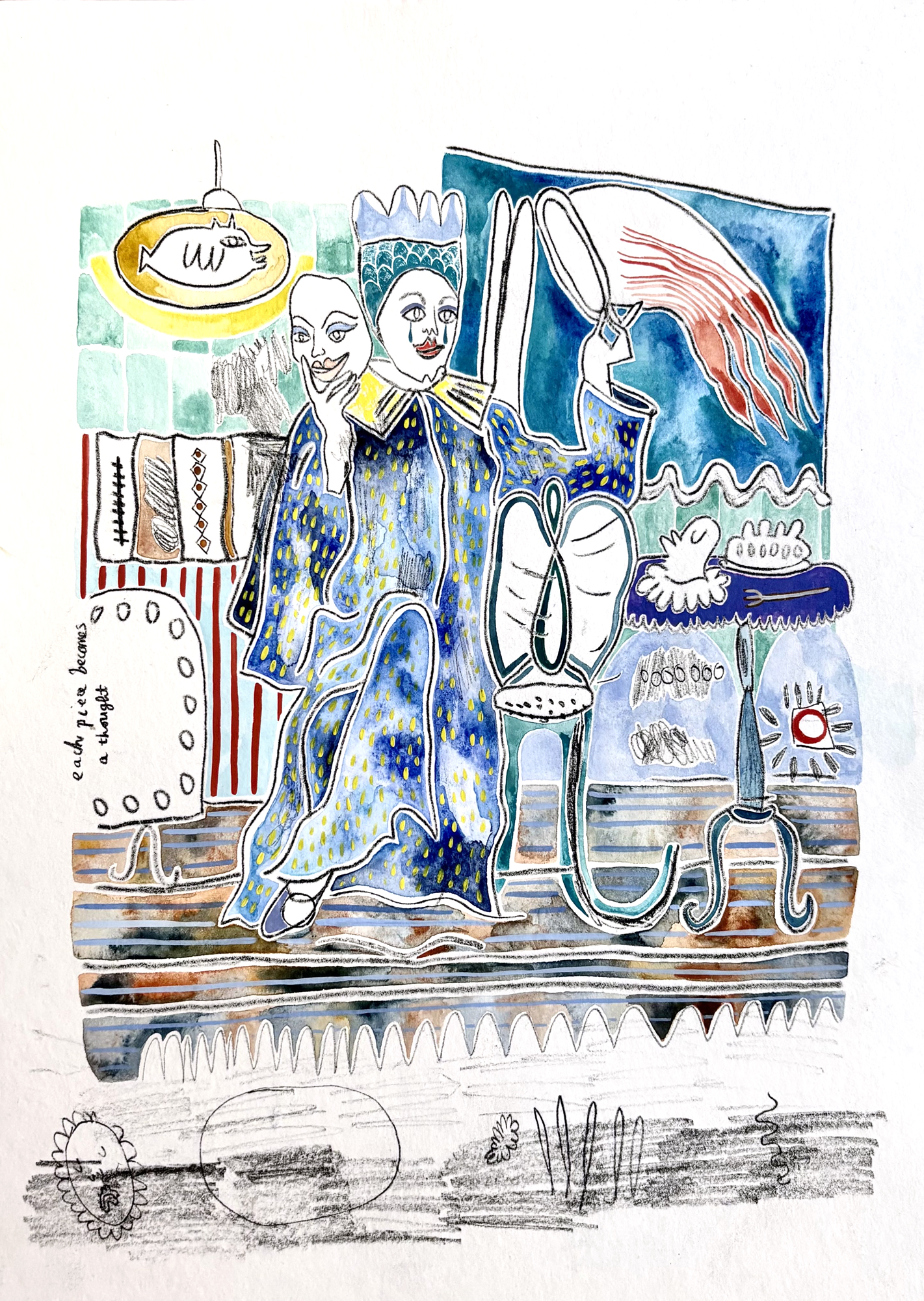
Fiona Beveridge is a visual artist living and working in Leith, Edinburgh. She works across printmaking, painting, sculpture and textiles. One of the main themes present within her work is myth and folklore. Her interests and inspirations are the mystical and supernatural, imaginative experiences within the everyday, craftmanship of the Victorian era, medieval architecture, animal behaviours, plant lore, ghost stories and colour. Fiona collects small and visually stimulating items varying from a peculiarly shaped shard of plastic old pieces of jewellery, to photographs and homemade cassette tapes, and uses such findings to piece together a narrative. The stories evolve into a visual language within the studio environment through mainly object placement, collage and drawing to become works which contain pieces of everyday life, history and mysticism.
See Fiona’s work as part of our annual Autumn open call exhibition, We Fear Nae Evil. Six Foot Gallery is delighted to host thirty three artists exploring the strange and magical stories of Scottish Folklore. Our Sextet listening station is back with twenty-four new pieces for you to spend some quality time with.
Hi Fiona! What advice would you give artists who are just starting out?
My advice is to trust and nurture the imagination. Life can be quite unpredictable in a lot of ways so I think it’s important to navigate challenges by processing them through your own working methods and transforming different experiences into artworks. Something I’ve realised over time is the importance of giving yourself time and space to experiment. Trying out as many techniques as you can and exploring something new can bring interesting surprises that can lead to a whole new pathway of creativity and outcomes. Use whatever you have around you, art can be made from nothing and anything.
How has your practice changed over time?
When I was doing my undergrad at ECA between 2011-2014, I studied BA Sculpture, but ended up switching to Painting for a year. It meant at the time I was able to make the most of both courses. I struggle even now to define myself as one type of art practitioner because there are so many different ways of making to explore. A lot of my early sculptural work was quite minimal, with a strong focus on shape and colour, using everyday objects as tools for drawing and other mark-making techniques. I did a residency in Oaxaca, Mexico a few years after graduating, and studied natural dyeing processes at a cochineal and cactus farm, as well as handmade paper from fruit and plant fibres at a local paper factory. We learned mainly how carmine was made from the cochineal insect, and also how food and cosmetics are coloured with the pigment. The experience gave me a whole new insight and interest into colour pigmentation, plus the craftsmanship of art materials and also paper. I became obsessed with paper and colour mixing. By using my studio as a kind of incubator for experimentation and play, my work has fluctuated between drawing, photography, painting, printmaking, film and sculpture. I still feel I have so much to learn though and think my practice will continue to evolve every day.
How do you overcome creative blocks?
Sometimes I see them as a sign to pause and reflect about what I’m actually doing, or think about areas of my practice that maybe I’ve been neglecting or even focussing too intensely on without realising. During these block periods, I try to change my environment, by either doing things like rearranging my studio space, cycling to a body of water, or visiting places that I find creatively stimulating. I usually get the train to random places, take a sketchbook and some art supplies, and mostly focus on drawing or photographing. I love to document my surroundings and experiences, so usually trips like these that involve a change of environment really help because I always see something new.
Which artists inspire you? Are there non-artistic influences such as literature or music that impact your work?
There are a few artists who mainly work in painting and sculpture that I always go back to: Eileen Agar, Leonora Carrington, Niki de Saint Phalle, Graeme Todd, Juan Soriano, and Frida Khalo. In day-to-day life though I’m mostly inspired by comics, graphic novels and zine makers. Some illustrators that have inspired me recently are Anna Haifisch; Andrew Pilkinton, who is behind Mozzarella Pizza; Scott Musgrove, who is the creator of Fat Dog; Mendoza cartoons and comics; Jesse Jacobs’ New Pets; and the visual diaries of Tara Booth. At the moment, I’m a bit obsessed with the postcard collection of William Ouellette, who curated a publication about his collection of antique fantasy postcards. He is a collector of advertising objects and ephemeral novelties. Some of the postcards in his collection feature enlarged animals, surrealist collage and ghost sightings. As for a musical influence, I would say The Flying Lizards. I got into them from collecting their vinyl lp singles which are artworks in themselves. The first one I got was their cover of Summertime Blues. Their music is avant garde, a bit warped, and experimental with elements of poetry. I also really admire the songs of Scottish folk singer Jeanie Robertson, who sings old tales and experiences of peoples’ lives within the towns and villages. Her lyrics are a real insight into the history of peoples’ characters and surroundings.
My favourite are the images that come in dreams! I do extremely simplified blocking What do you do to keep motivated and interested in your work?
I think it’s important for me to remain curious and remind myself that inspiration can be found in everything, so I try to approach new experiences with an open mind. I keep motivated by having both a workspace at home and a studio to go to. My workspace feels more like a place where I can do laptop-based things like check out upcoming opportunities, scan work to sell as prints, use photoshop, write and apply to different projects etc. Whereas my studio is filled with mixed media experiments, a lot of works in progress and most of my materials. It also has no internet connection, which can be pretty refreshing as it encourages me to use my hands more. Managing my time has been quite a challenge in the past as I used to work full-time between a venue and managing a retail shop, so I ended up having absolutely no time to make any art or creative decisions for myself, and it became a real struggle mentally while trying to maintain my own practice as my motivation was gone. But I think the realisation of how precious time is was a real transition, and so I found a way to work part-time selling art materials, and work freelance as a vintage and antique object restorer. I fix up old items and resell them online and at vintage markets. These aren’t amazingly paid sources of regular income but for me personally, it means that I don’t get fired for wanting to take time off to do an artist residency or put on an exhibition, which is a true reality that I have had experience of as a working-class artist. Finding balance and the extra time to create never feels wasted and is one of the main things that allows my motivation to flourish.
Are there any upcoming events or additional information you would like the audience to know?
I’m in the process of organising my first art market, which is taking place on Sunday 22nd November at Settlement Projects in central Edinburgh. I find markets an accessible way to meet new artists and connect with people so I’m excited to be putting one on. I’ll have a table there too, and will be selling screen printed clothing, prints of my work and small sculptures. It’s being promoted under 24 Hour Window, which is a project I’ve been running since 2018. It’s a platform that offers artists free exhibition opportunities in Edinburgh and Glasgow through collaborations with alternative gallery spaces. The most recent exhibition was by artist and musician Perry O’bray who did a large-scale window installation in Settlement Projects for a whole month. Because Settlement Projects is a shop, we were able to facilitate the sale of all his work as well, so it’s great to be able to support other artists in these ways. Previously, I used the gallery space within Sett Studios to host a mix of open call and invited artists’ work, and before that it was monthly artists’ takeovers within a large vacant window space on King Street, Glasgow. To keep up with future projects or check out the archive, the Instagram is @24hourwindow.
Find out more about Fiona’s work on Instagram or on her website. We Fear Nae Evil runs at Six Foot Gallery until Friday 16th October.
Leave a Reply