Lin Cheng is a Glasgow-based visual artist whose practice spans painting, illustration, experimental animation, and installation. She works internationally, with recent exhibitions in New York, Paris, Beijing, and London, including participation in the 2025 London Design Festival. Cheng’s cross-media storytelling investigates female subjectivity, collective memory, and the tension between self and environment. Drawing from Chinese cultural traditions and global feminist discourse, her work engages with urgent social themes such as domestic violence, migration, and belonging. Alongside these critical explorations, Cheng also incorporates a child’s-eye perspective, creating works that balance vulnerability with playfulness. This dual lens allows her to address profound societal issues while also celebrating imagination, empathy, and resilience. Through this layered approach, Cheng bridges personal narratives and collective experiences, connecting local communities with global conversations through powerful, silent visual languages.
See Lin’s work as part of our annual autumn open call exhibition, Future/Past, featuring a sublime collection of works by twenty six artists inspired by ancestral echoes and future visions; pieces that dismantle tradition, reimagine narratives, and linger in the margins of the radical, the oneiric, and the everyday.
Hi Lin! Tell us, how did you arrive at the theme of your work?
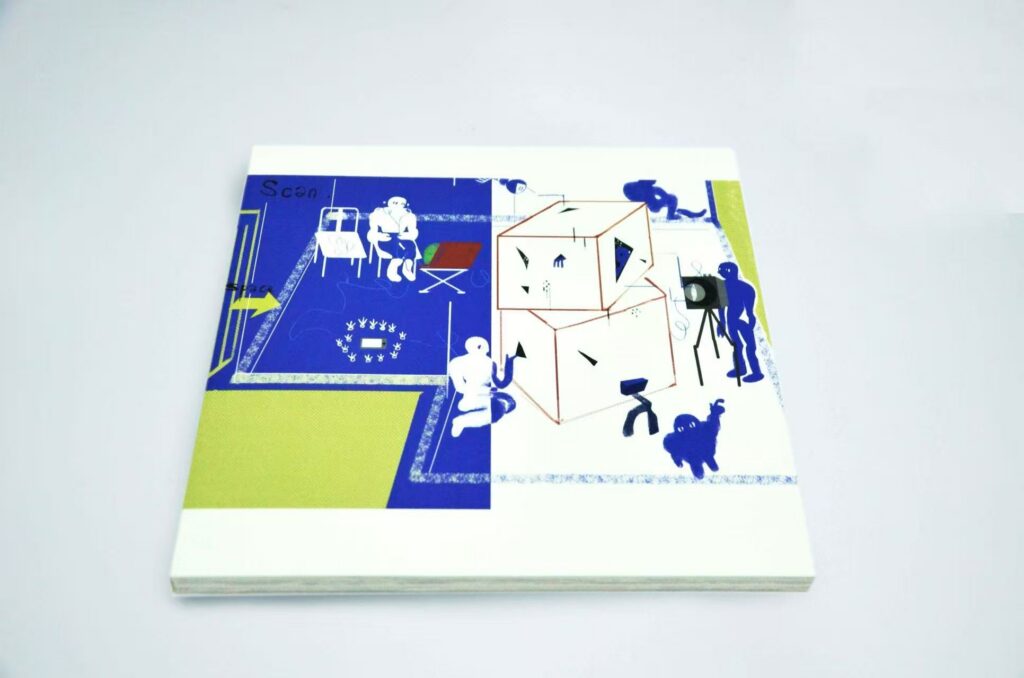
The wordless book Relation, which I am exhibiting here, began with a group visual experiment. In this experiment, we explored interactions between people and cardboard boxes, incorporating lighting and shifting lines of sight. This sparked my interest in the dynamics of gaze and being gazed at, and how unequal positions distort perception.
The book is divided into three chapters on tracing paper, each exploring how an individual feels when entering a new collective. These ideas come from my own experience of living a transient life, constantly moving between cities and even countries – a condition faced by many in my generation.
In the final scene, the main figure curls up in a fetal position, and the surrounding crowd mirrors this gesture. It creates a sense of shared safety and belonging, yet also erases individual differences. The work asks: how close is too close, and how distant is too far, for a relationship to remain healthy? This tension between intimacy and autonomy forms the central theme of the book.
Can you walk us through your creative process?
My creative process was not straightforward. I initially worked within a group visual experiment, but we soon developed divergent interpretations. Our different professional backgrounds became both the source of conflict and a point of reflection. This experience made me think deeply about the relationship between collaboration and independent authorship.
While working on the project, I began to sketch a series of small, melancholy blue figures. These figures felt fluid, like rivers or surging emotions. The tension between individual and collective gradually became more dramatic, and from this, the story of Relation began to unfold.
I started with pencil sketches, later refining them digitally, while also including ballpoint pen drawings within the book. These mixed techniques allowed me to express both raw immediacy and careful composition, reflecting the duality of internal emotion and external social structures.
Are there specific advantages or challenges associated with working in your chosen mediums? Have you experimented with other mediums or techniques?
For this book, I used mixed media – photography, ballpoint sketches, and digital drawing. I have also explored papercutting and printmaking, which I see as promising directions for future projects.
From initial inspiration to final completion, my process begins by defining the core message I want to convey. I then break it down into individual images, refining each one carefully. When I have a large enough body of work, I experiment with their sequence and arrangement, experiencing the piece as a reader would. This helps me make final adjustments so that the overall narrative feels immersive and cohesive.
Looking ahead, I plan to continue incorporating experimental materials to expand the visual and emotional range of my storytelling.
How do you know when a piece is complete?My first illustration teacher once taught me a valuable lesson: do not become trapped in details. Instead, step back and look at your work from the position where you imagine the audience will stand – not too close, not too distant.
Early in an artist’s career, it is natural to obsess over details, as they are essential for capturing attention. However, as you create more work and encounter a broader range of artistic practices, you begin to realise that perfect detail does not necessarily equal a complete work.
Completion comes when the piece communicates its core message clearly and evokes a meaningful response. At that point, adding more detail may not enhance the work – it may even diminish its power.
Is there anything else you would like people to know about your work or your experiences as an artist?
I was fortunate to begin my artistic journey in an illustration studio during university, which gave me a solid foundation. Moving to London exposed me to artists with diverse international backgrounds, expanding my understanding of what it means to work as a full-time professional artist.
In Glasgow, I found a vibrant, supportive artist community and gallery network. Through conversations with curators and peers, I learned the importance of professional practice, international exchange, and the role of art within local communities.
For an independent artist, these three elements – specialized knowledge, global perspective, and community engagement – are essential for sustainable creative growth. My work continues to evolve at the intersection of these values, bridging personal narratives and broader cultural dialogues.
What do you do to keep motivated and interested in your work?
I am grateful that drawing and painting never feel like exhausting labour to me. Instead, they are intuitive acts of expression and self-discovery.
Currently, I am exploring new forms of narrative, which sometimes require complex story structures and repeated revisions. Even when the process becomes challenging, I deeply enjoy the moments of immersion – losing track of time while fully engaged in creation.
Equally meaningful is the dialogue between my work and its audience. When viewers connect with my pieces, I feel that my inner experiences have been seen and shared, creating a bridge between personal memory and collective understanding.
I would also like to thank Director Fee and the volunteer team at Six Foot Gallery for their support. Their efforts have made it possible for my work to reach wider audiences and continue to grow.
Find out more about Lin’s work on Instagram or on her website. Future/Past runs at Six Foot Gallery until Tuesday 14th October.
Leave a Reply