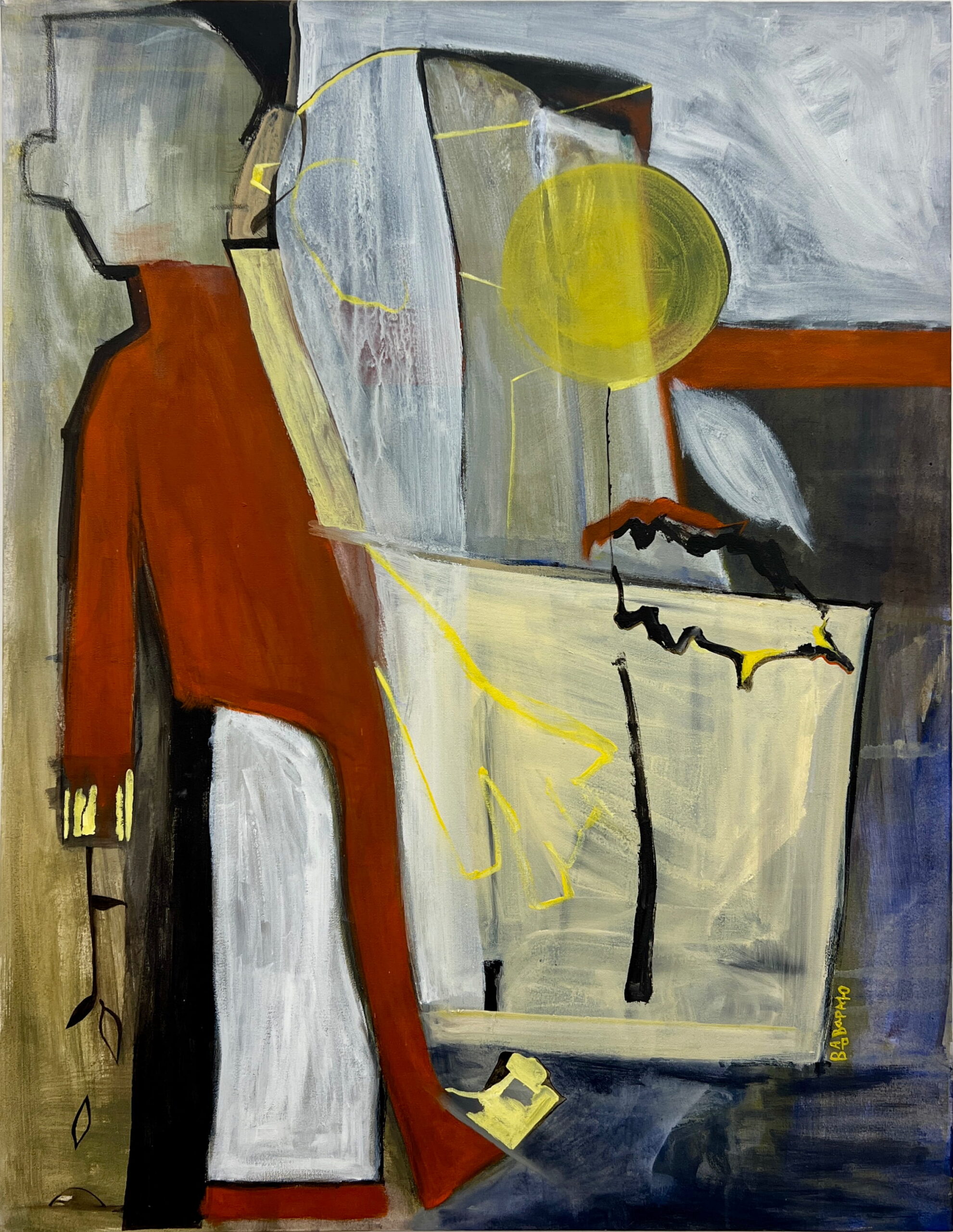
Varvara is a Ukrainian multimedia artist, currently based in Scotland. Varvara is interested in building her own worlds, but also explores being one with the real world. She plays with the feelings of her audience, exploring whether they can blur the lines that are separating these worlds: the one created by her, the one created by the viewer, the one they see, the one they imagine, and the one they want to be present in, asking whether they see signs of morality, themselves, and what is happening around them. Varvara likes to think that people become the actors in her play, and without their presence, the work would not exist. Silhouettes create a dynamic plot, and bold colours play with one another. Shapes act as punctuation marks in this visual language – circles of connection, sharp lines of rupture, shadows that suggest rather than declare.
See Varvara’s work as part of our annual spring exhibition Offerings, exploring the ways that hope and creativity can take root in hostile environments. Inspired by queer histories of creating against all odds, and by the ways communities nurture possibility and make offerings for the future, Offerings showcases works that bring warmth, colour, and a sense of renewal, that soften the spaces they inhabit, or that suggest endurance or growth: no matter how harsh the winter, the flowers will bloom again.
Hi Varvara! Can you elaborate on the significance or symbolism of the chosen title of your work?
Every title of a work is significant to me. This year, while completing my studies at the Glasgow School of Art, I wrote my extended essay on the topic of the importance of titling artworks – the idea of verbal colour, where I researched different artists and how they use ‘this colour’. Some of them play with metaphors, some write and use long sentences as the titles of their works. I do not like to directly tell what is happening in my artwork: when people ask me what my work is about, I tell them only one word – people. However, the titles of my paintings say more than one word. And although I understand that these words will be read differently, they will not give, perhaps, the specific answer that the viewer hopes for, but for me it is an extension not only of the canvas itself, it is my way of speaking and hoping that someone will read my title as it was intended. Even with this artwork – I am one meter 60, but I touch the sun, I can only add that I am one meter 60 in height, and I will leave the rest for guesses.
How do you typically approach your creative process from initial inspiration to the completion of your artwork?
Very often I look for something to grab onto to start working. I like to think and call myself a designer who transforms and creates. So most of my works start with some interesting spot on the asphalt, spilled paint, objects that have formed an interesting composition, and in all this I saw some characters and some plot. I give these found objects roles, dress them in costumes, write a plot and create theatrical lighting. I talk to them, listen to their dialogues and suggestions, continue painting the canvas with them. When all the dialogues are finished, I call this theatrical production and release it on stage.
How do you know when a piece is complete?
How do I feel that the work is complete? I feel it. It is a special feeling that you really feel at some point. Of course, you can ask the person next to you – “Do you think my work is complete?” And hear yes or no. But it is felt inside yourself, whether it is really a yes or a no. Before, it was very difficult for me to listen to myself at all. I only paid attention to someone’s “yes”, someone’s “no”, and only when I started to trust myself and my decisions – my works, my canvases began to speak and communicate with me.
How did you arrive at the theme of your work?
It took me a while. During these three years of my intense existence as an artist, I tried to do something new and new every time. Although, it was always present in me. Even now, my presence here, in this city, in this gallery. At some point, when I really pushed myself completely forward with all my might, I stopped and this moment of reflection caught up with me. I remembered how “everything” began: how when I was little, I always picked up a camera and took thousands of photos. Later, I drew more, and these were portraits of people. Later, in the senior years of high school, I returned to the camera and took many photos every day. They were not portraits in the literal sense, but they were “portraits”. These are the portraits that were conveyed through light and shadow, the colours of objects, the compositions, a cat randomly running in the hustle and bustle of the city, my mother’s hands, my friend’s smile, the swallows that fly and sing in front of my balcony in May every year. I realised that it was always about portraiture, about stories, about people, even if there are no people in the frame. Now I tell these stories using all the media that I like and am interested in: painting, photography, sculpture, video and more. I believe that as an artist, you always know, you just may not have realised it yet, have not framed it.
Will your next project be a continuation of your current style or are you experimenting with something different? Can you share a glimpse of your next project?
My next project is a degree show in Glasgow School of Art, to which I invite everyone, of course. Yes, the exhibition is a project, because it summarises my studies for three years, but actually the exhibition itself contains many projects: each canvas is a separate project, my curatorial side of it, but there is one project that I would be interested in talking about. It is a project that includes costumes, but not costumes in the traditional sense. They are not sewn from fabric, they are not even intended to be actually worn. But they talk about something that I often mention in my paintings – about belonging. Through costumes and characters, who actually become characters through the ‘costume’ they wear, I will talk about the idea of home and who the person is in its sense. I consider it an extension of my practice, not something completely different. One of the teachers expressed the opinion that I should only focus on painting, and my other passions have no positive impact or connection with my work. And then I came across a quote by one of my favourite artists, Sonia Delaunay, which once again convinced me that it is important to listen to yourself as well. This quote actually answers your question: For me there is no gap between my painting and my so-called ‘decorative’ work. I never considered the minor arts to be artistically frustrating; on the contrary, it was an extension of my art
Are there any upcoming events or additional information you would like the audience to know?
Yes, as I mentioned earlier, the annual Degree Show Exhibition in The Glasgow School of Art will soon be taking place. The exhibition will run from 29 May to 7 June. We have several buildings, my exhibition will be held in the Stow building on the fourth floor. I hope you, the reader, will visit and read a few more of my works.
Also, one of my other multimedia projects that I recently started is the Blank Canvas podcast on YouTube. The idea of the podcast is that I have a blank canvas that I will paint with each new detail with each new conversation. In the podcast, I talk to different people: different ages, different professions, with different experiences, but somehow art unites them, and the conversation fills and leaves a mark not only on my canvas, but also on the perhaps canvas of the one watching.
OFFERINGS runs at Six Foot Gallery until 21st April 2026. Connect with Varvara on Instagram.
Leave a Reply