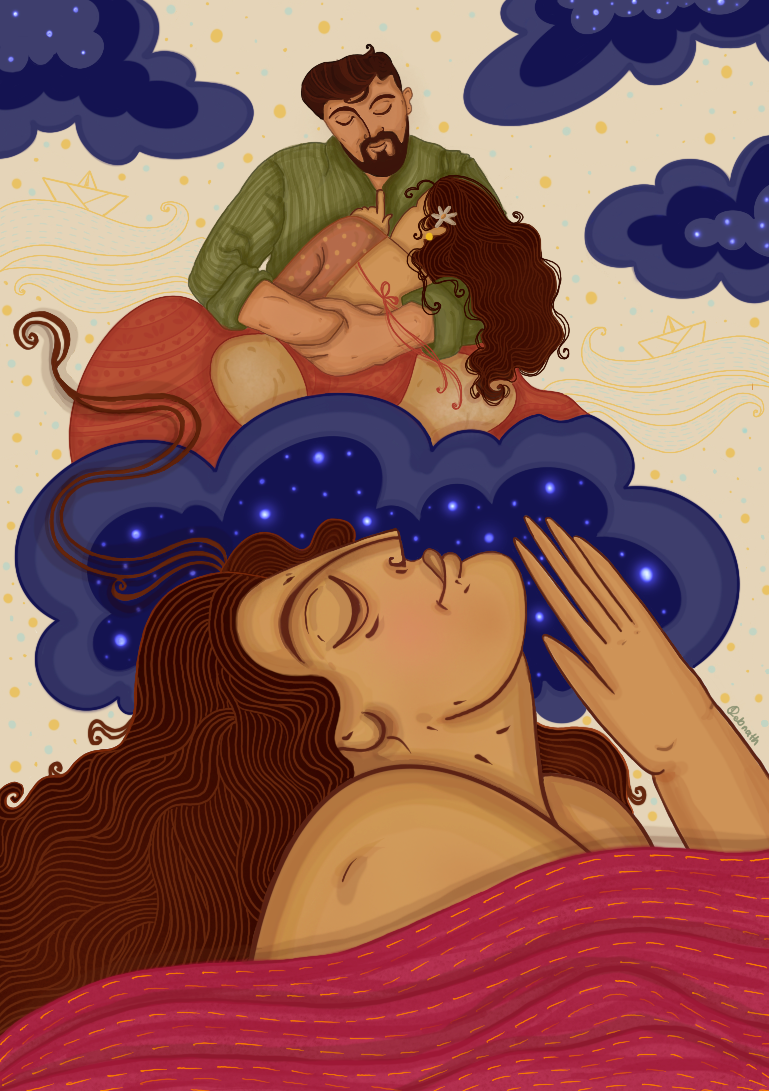
Ipshita D.W Meyer’s Systems and Souls address the human relationships that live and breathe inside the social and cultural practices within our contemporary communities. She explores the societal (system) customs and human perception (souls) towards it. Through her unique art style and design, Ipshita uses symbolism to unearth aspects of social discrimination, cultural norms and practices, as well as the social interactions humans have developed and their relationships towards these long-established habits and traditions. She translates these ideas in her art through storytelling with energetic juxtaposition of bold and vibrant colours, textures and figurative abstractions.
Thanks for being with us, Ipshita! Can you tell us how your artistic journey started?
I began drawing from the tender age of four, as my parents, sometimes, like to recall those joyous moments of some peace and solitude they enjoyed, whilst I played with colours. To me art has always been a medium of self-expression – an outlet from all the pressures and follies in my social world. However, speaking with complete honesty, whilst growing up, my art was simply an imitation of others’ works of life, and therefore it lacked purpose to me. As a result, for many years to come, I endured a constant battle with my innermost being to unearth my very own expression of creativity, and dare I say, it was not easy. In my early twenties, with the opportunity to move to the UK and expand my academic career in social sciences, I simply couldn’t find the time to draw. Under this mounting academic stress, my zeal for art laid dormant for a very long time and finally erupted with an objective to voice my own thoughts. I realised that all my academic work was just another page in a book, easily read, accompanied with a few discussions and then soon forgotten. I recognised that although words can have a profound effect (exemplifying the most historical statement, ‘the pen is mightier than the sword’ by Edward Bulwer-Lytton); to me nothing compares to the ripple of change and the flow of dialogue that can be created through art (or as Edward Hopper puts it, ‘if I could say it in words, there would be no reason to paint’). And this realisation began my artistic journey.
How did you arrive at the theme of your work?
To understand the themes of my artworks, and not just those present at the exhibition, you have to understand my background and where I come from. As an Indian, I was taught from a young age to accept and follow social rules for what they are and never to question them. I clearly remember my mother saying, “Women have their role in society, and we must do what is expected of us”. Strangely enough, even in my prepubescent brain, I simply could not accept my mother’s statement. Growing up through every stage of my life, I questioned the conventional rules of society – ‘How’, ‘Why’ and ‘Why Not’ – and I fully admit, this critical thinking of mine did not sit well with the elders in my family who warned me of my scepticism. My incessant questioning used to drive my mother berserk, to such a point that she would yell out, “Enough with the why’s! That’s how things are and you must follow them!”. Even as a child, the fear of facing a dire repercussion for questioning the preordained social norms, did not diminish my disagreements of blindly following antiquated social values. In fact, with my education and academic work of Sociology and Anthropology has helped me in observing my social environment better and carefully study the patterns of human behaviour along with their thought processes. It is through this inquisition of continuous learning, coupled together with my own life experiences, which I have gained so far, has helped me shape my present artworks.
Can you walk us through your creative process?
With all the social and cultural experiences, I have gained so far and still acquiring, I can now freely express myself through my art. My aim is to create visually appealing pieces dominated by bold yet varied colours, patterns and designs that portray my Indian heritage, whilst providing a powerful social message. As an artist, my objective is to create something unconventional that generates new curiosity, dialogue and conversation for viewers across all ages. And if I may be so bold to say, I am conscious that my work does not strictly fit into the framework of Western and/or contemporary fine art and this is what potentially distinguishes me from other artists; for my artworks are a continuous search for the best way to interpret the knowledge I have of the modern society we live in.
How do you overcome creative blocks?
We are living in an age of social media where there is a greater need for constant social acceptance and validation. There is always a level of urgency for artists, especially on social platforms to produce as many artworks as possible, simply to remain relevant; and with all honesty, I was no different. As an underrepresented Indian fine artist, I felt extremely fragile since I wanted to make my mark with my artworks; and as mentioned previously, my artworks are conventionally quite different from western and/or contemporary fine art, therefore, it became a matter of seriousness for me to produce as numerous art pieces as possible. But this unhealthy need to constantly produce art for the sake of some mere recognition, started to drain me physically, emotionally and mentally. In a way, you could say I was morally fatigued. I hit a huge creative block, and for months I stopped drawing, during which I simply unwound myself with activities that brought me joy, comfort and a realisation that it is okay to take a break. Quality is of far greater importance than quantity, because art is something that needs to come from within – it cannot be rushed and it definitely cannot be forced! One needs to feel it to create it. So…. take a break and begin when you are ready.
Which artists inspire you? Are there non-artistic influences such as literature or music that impact your work?
As a fine artist I personally find it extremely difficult to make preferences for some over the others, for I like all artists! However, if I do have to pick, I admire Frida Kahlo for her raw, symbolic self-portraits as she never shied away from expressing her emotional, physical and personal trauma. Amrita Sher-Gil, a Hungarian-Indian painter, who often depicted the everyday lives of ordinary Indian women. And finally, Jamini Roy from my home state West Bengal, India, who is known for his Bengali Folk Art and (almost extinct form of) Kalighata Folk Art. The uniqueness of each of these artists and despite having different cultural backgrounds and education, the common ground is that they are all bold in their approach. They drew inspiration from their personal experiences and what they observed around them, and I am no different. Yes, I read various literature and listen to music that moves me – but they all create an essence and form an integral part of my artworks. The crux of the matter is, that there is no single subject, object, or being that inspires me. Our knowledge and society are ever changing because there is inspiration everywhere – there is a story all around us! All we have to do is keep our eyes, heart and mind open.
What emotions or reactions do you hope viewers experience when they see your artwork?
As a former social researcher, I cannot refrain myself from creating socially poignant artworks that I see and feel. This has become my natural response to every art piece I create – it produces some sort of ‘tickle in the brain’ for me that I live to repeat, and I hope to generate the same reaction for my viewers. Each of my artworks narrates an intricate story and therefore, are meant to be analysed, because symbolism is abundant in them. As such, the works I create calls for the participation of the audience to the same extent as my involvement in it.
Will your next project be a continuation of your current style or are you experimenting with something different? Can you share a glimpse of your next project?
Ooohhh…… I have so many new ideas and I cannot wait to get working on them! When I have all these ideas and themes just running amuck in my head, it becomes an insatiable itch for me. In these new art pieces, I will be experimenting a bit more with Indian, Scandinavian and Eastern European folk art while incorporating them into my present art style. I have recently started researching folk art and found it extremely interesting how European folk art has so many similarities with Indian folk art. Despite being culturally apart, they are both rooted into the tradition of storytelling and similar to my art style, they are all symbolic in nature. One of the artworks that I will be working on is going to be nature and environmental theme and will heavily rely on both my artistic style and European and Indian folk art. I believe this will be one of the most intricate works of mine till date. Oh! I am getting all giddy with excitement just thinking about it!
Systems and Souls by Ipshita D.W. Meyer runs at Six Foot Gallery until Thursday 18th June 2026. Connect with Ipshita over on Instagram.
Leave a Reply