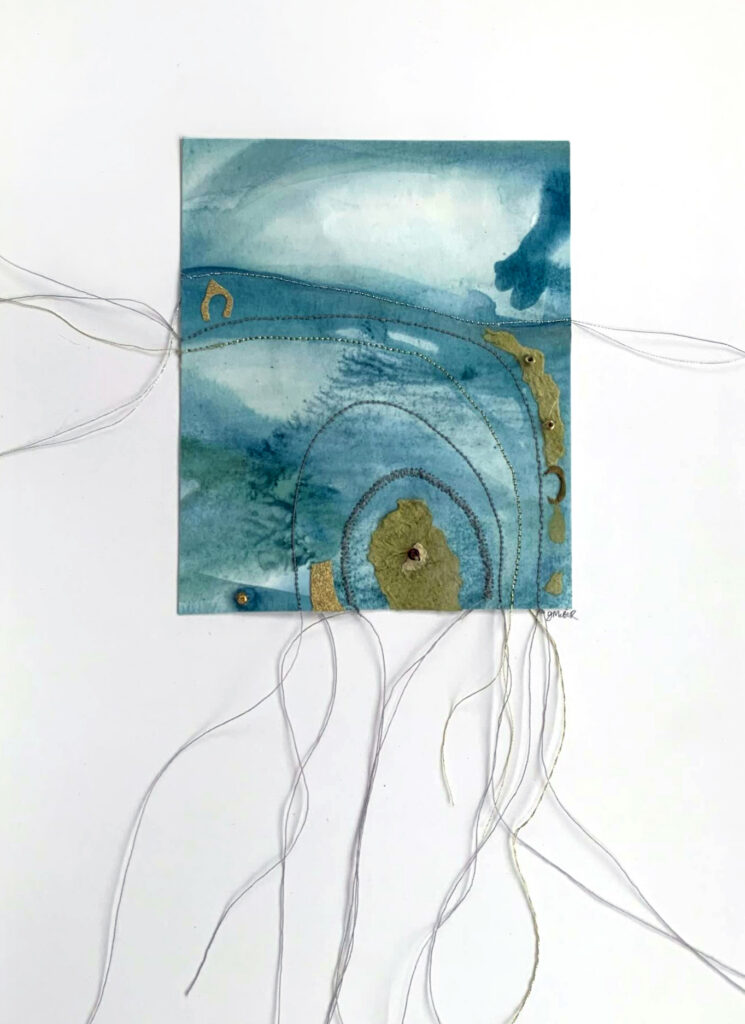
Gill graduated in 1989 with a BA (Hons) from Duncan of Jordanstone College of Art in Dundee. She worked teaching art and design in Fife, Lanarkshire, and Argyll and Bute before settling in Glasgow. Having swapped the countryside for the city, Gill’s appreciation of rural life and natures landscape have become a growing focus in her work. In 2024 Gill left teaching to focus full-time on her own artwork. She draws from her background in tapestry and papermaking to source fabrics and explore different surface textures. Adding ornamentation and a sense of the precious she incorporate beading and metallics to pieces to celebrate and evoke the delicate beauty of nature and its balance. Threads and needles are used as drawing tools and hark back to her days of warp and weft at the tapestry loom which serve as a metaphor for the emotional ties she has with the landscape.
See Gill’s work as part of our annual spring exhibition Offerings, exploring the ways that hope and creativity can take root in hostile environments. Inspired by queer histories of creating against all odds, and by the ways communities nurture possibility and make offerings for the future, Offerings showcases works that bring warmth, colour, and a sense of renewal, that soften the spaces they inhabit, or that suggest endurance or growth: no matter how harsh the winter, the flowers will bloom again.
Hi Gill! Can you tell us how your artistic journey started?
I didn’t come from an arty background and only discovered that I could draw reasonably well in my teens, while being bored in Chemistry and drawing my classmates! I switched to art in senior school, falling in love with the creative process, and then on to DJCA, Dundee.
However, I think my journey as an artist started when I went into my fourth year of my degree. I was tired of not pleasing some tutors and not understanding why. Perhaps because my work did not fit neatly into the course and so, I decided to follow my own instincts. Having the confidence to listen to myself and to develop my own creative instinct coupled with thoughtful support and guidance, I began to hear my own voice which informs my work still.
How do you overcome creative blocks?
I work on several pieces at a time for this very reason as I will get ‘stuck’ regularly while making pieces. My best solution is to walk away and not wrestle with indecision and to do something else, work on another piece, start something new, prep papers, do drawing or printmaking. Through experience, I have the confidence of knowing that an idea will always be there but sometimes I have to step back from a particular work to re-focus on the clarity of my original concept.
Can you walk us through your creative process?
I very much work in stages. I won’t refer to images during the making process but rather draw on memory and a feeling or sense of place while I create. Once I have decided on the place that I’m attracted to, I create a series of papers of different surface qualities and weights with washes, splodges and brush marks using gouache and watercolours in that colour palette. I attempt to have contrasts and to allow the materials ‘be’ – pooling, bleeding, patchy areas and blending colours come from this. When dry I select from the papers areas that have interesting marks or which naturally reference or lend themselves to suggest the landscape. These ‘found’ marks add a uniqueness to each piece. At this stage I crop and then work into these focusing on tonal contrast and colour saturation – sometimes adding, sometimes washing away. This can be immediate or take several sessions of work to get the balance. Once the base for the image is in place, I use dyed or painted papers and fabrics to add compositional interest through shape. Collaging like this allows me to make large or tiny changes before finalising the placement of these shapes in the composition. This can be time-consuming cutting and tearing placing and moving many times. This is often the most challenging part of the process and where I am most likely to need to walk away. I will work across several pieces intensely at this stage to give me thinking time between the pieces. Once the decision has been made, I then move pieces to the sewing machine where I use a stitched line to reference the contours of the land or the lines from ordnance survey maps. The ‘tails’ of the threads of the threads will become part of the final composition so the number of these, colour, and placement all count. I work instinctively through this again starting and stopping with several pieces. Treating the paper as a textile I add beads (usually) to pieces to create a sense of the precious and to lead the eye through the composition. The final phase is the placing of the made piece and the threads onto a backing. The threads need to be secured in places to ensure they echo the rhythm of the landscape.
What emotions or reactions do you hope viewers experience when they see your artwork?
I strive to make work which has the potential to be uplifting. If my work can evoke a sensation of pausing, remembrance, a moment of escape, or instigate a flight of fancy while the viewer creates a narrative. If it can create a sense of the connection to the natural world as something fragile yet resilient, then it has fulfilled its role.
Which artists inspire you? Are there non-artistic influences such as literature or music that impact your work?
Ideas and aesthetic influences come from a variety of artworks. I am often selecting aspects of aesthetics which resonate with me- from the likes of Byzantine religious art to Klimt’s use of metallics to add a sense of the precious. Fra Angelico’s blue – it’s just so perfect! In terms of technique and concept; Antoni Tapies has been a long-standing influence. Focusing on mark-making and spontaneity, and the idea that an image is like an open door for the viewer to enter and explore ideas and emotions as they go on their journey with the work. Surrendering the work to the viewer, their experience of the work, and posing questions rather than giving answers are all concepts I have embraced for some time now. The connectivity and the relationship of colour to emotions is something I learn about each time I look at the work of Mark Rothko. Creating balance through colour is something I strive for in every piece I create. Contemporary Scottish artist Christopher Wood has also been a strong influence. His presentation of the Scottish landscape has become increasingly abstracted over the years. He cites, ‘the language of landscape’ in his colourful, textural, and compositionally unorthodox work. His pieces inspire me to create compositions that simply feel right and to focus on the emotional experience of place rather than a particular likeness.
What advice would you give to artists who are just starting out?
Having only recently started to exhibit work after years of not doing so, there is a degree of ‘just starting out’ that applies to me, and I’m certainly in the learning phase when it comes to all things admin and the time and effort that this takes. When it comes to your own practice, as Matisse said, ‘creativity takes courage’. Be willing to take risks and experiment. Keep looking, be it at your subject or other artists practices. Challenge yourself, it is exhilarating and can take you on amazing journeys. Expect failures, you learn so much from them. Trust your ideas and don’t be afraid to re-work them when you take a wrong turn. Most of all, be true to your inner voice and make art that pleases you.
OFFERINGS runs at Six Foot Gallery until 21st April 2026. Connect with Gill on Instagram, or on her website.

Leave a Reply