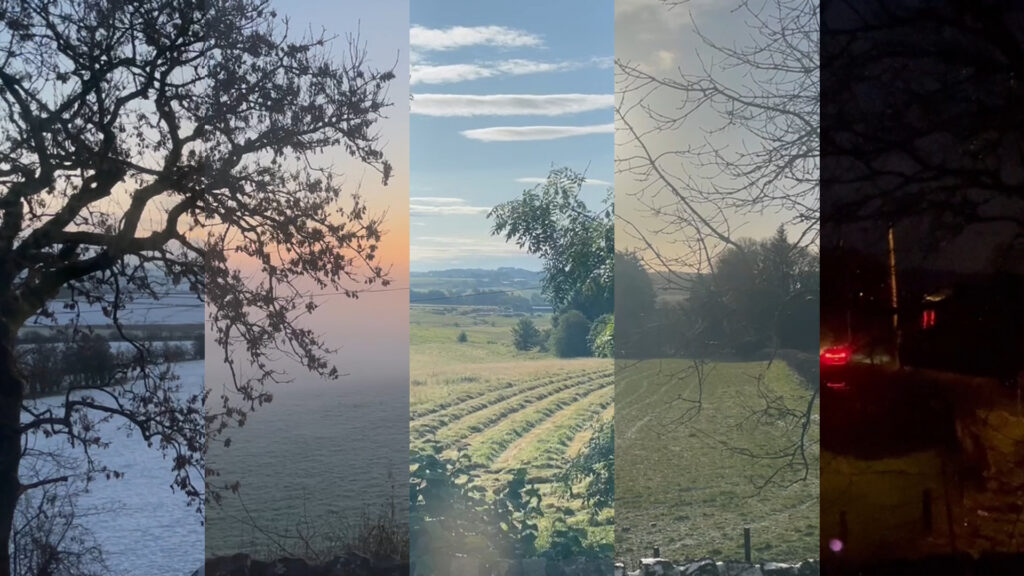
Dougie is primarily a composer and musician who works with field recordings, found and sampled sounds, and all kinds of electronic instruments. His work focuses heavily on sound texture using degradation and manipulation as production techniques to find new and interesting applications of these sources. His recent work has been towards finding new outlets beyond an audio only approach, including making compositions for use as part of sculptures, both collaboratively and of his own making, and also branching out to soundtracks. In addition to his more experimental work, Dougie also writes, records, and releases music under the name Unthank, available on Bandcamp and through all major streaming services. His most recent release is an album inspired by the work of David Lynch, featuring poetry written by Six Foot Gallery’s own Fee.
See Dougie’s work as part of our annual summer open call exhibition, Melting Point. While days grow long and shorts shorten, Six Foot Gallery is delighted to host twenty nine artists exploring art as an alchemical process; the heat of summer as an artistic catalyst, plus our Sextet listening station is back with twenty-one new pieces for you to spend some quality time with.
Hi Dougie! Can you walk us through your creative process?
This project began with the videos. I decided, with no real intention, to take a video of the view from our kitchen every day at the same time for a year. Eight in the morning was a logical choice; it was dark when I started but I knew it’d be light for most of the year at that time and it’s around then I leave for work each day, so I’d be there at the right time more often than not. When I started I had no idea what I’d do with the videos, I just thought it’d be interesting to do and see the results of the daily recordings. Once I’d finished the full year I stuck them all together, sped them up, and made a two minute video showing the whole year, which I loved. I started thinking about using the video at normal speed as the visual component of an audio project, since my main focus has always been music. I started out making music for the full thirty six minutes, but I soon realised I needed some written component as well – the track seemed empty otherwise, and the audio had little connection to the video. After a long process of writing the music, having finished the whole thing, I went on a week long course studying composition for film and stage at Ultima Vez in Brussels, and on my return decided to start from scratch. I threw out all the music I’d made and began again, making something more intentionally related to the video that reflected the seasons passing, the changing weather, and the text I’d written and recorded. I’m much happier with the second version.
How did you arrive at the theme of your work?
The theme came part of the way through the process. There was no intention in capturing the videos besides an interest in seeing what they would look like all strung together and thinking it would be an interesting thing to try to do. Having made it and watched it though, it’s very hard to do anything with it other than to comment on the natural world depicted in it, both the good and the bad. I love living where I live and being surrounded by fields and watching how the variety of life changes and adapts and grows through the year. I feel more connected to and reflective of that than I ever did living in a larger town. It’s also impossible not to notice the effects of climate change on how the years change and progress. The videos were all taken in 2023 and just three years later it’s clear that summers and winters are hotter and springs and autumns are wetter than they were back then. My love of where I live feeds in to my worries about the changes we’re facing, and the piece could only ever reflect both sides of that.
What advice would you give to artists who are just starting out?
Something I definitely learned from this project, which I think I already knew and practiced to some extent but which became all the clearer here, is the value in not mapping everything out ahead. At the start of a project or piece you don’t need to know what it’s for, what the message is, or even what it will be when you’re done with it. You can approach things as a form of play, to just do something because you want to see what happens and from that beginning react to what you’ve done, add to it, consider it and through that bring about an intentionality and direction you didn’t consciously start out with. I think sometimes if you start with the whole fully formed idea you restrict how something might turn out and that can be limiting or destructive, so don’t stop yourself from starting something new or different just because you don’t know what it will be – just try it and find out.
Find out more about Dougie and his work here. Melting Point runs at Six Foot Gallery until Thursday 9th July.
Leave a Reply