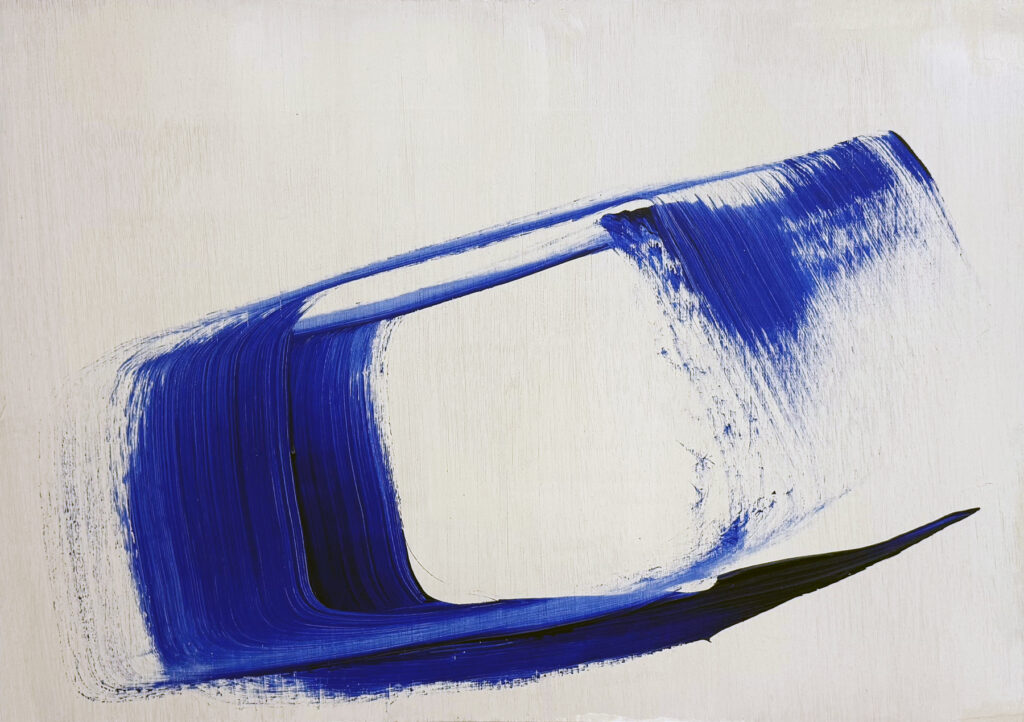
Claudine is an Irish artist based in Glasgow. Working across drawing and painting, her practice explores movement, perception and abstraction through a framework she calls Movement as Method. Using endurance running as a form of field research, O’Sullivan generates drawings, notes and observations that are later distilled into paintings. Rather than depicting landscape, the work investigates how repetition, duration and spatial awareness can be translated into abstract form. Recent work has shifted from describing movement as trajectory towards exploring enclosure, containment and negative space. Through processes of reduction and repetition, O’Sullivan creates paintings that register embodied experience while allowing form to emerge from sustained attention and physical engagement with place. She recently undertook a residency at Cove Park, Scotland.
See Claudine’s work as part of our annual summer open call exhibition, Melting Point. While days grow long and shorts shorten, Six Foot Gallery is delighted to host twenty nine artists exploring art as an alchemical process; the heat of summer as an artistic catalyst, plus our Sextet listening station is back with twenty-one new pieces for you to spend some quality time with.
Hi Claudine! How did your artistic journey start?
Like most people, art was part of my childhood. I’ve always drawn and communicated through images. My background is in design and I spent over a decade working as a commercial illustrator, creating work for clients including Apple, The Guardian and The National Trust. After moving to Glasgow, my practice gradually became more self-directed. While I still work with clients, my studio practice is now centred around Movement as Method, using running as a framework for drawing and painting.
How did you arrive at the theme of your work?
I started running two years ago and unexpectedly found a creative clarity afterwards. At the time, both my children were young and much of my energy was focused on motherhood. Running gave me physical, mental and creative space. After each run I began making quick graphite drawings and writing short journal notes. There was no plan. The process developed slowly alongside my running. I worked through landscape, colour, season and light before realising that the graphite studies interested me most. They felt direct and honest. They recorded movement, pressure, repetition and endurance. Earlier this year I undertook a residency at Cove Park. In the lead up, I spent a lot of time reflecting on what was working in the studio and what I wanted to pursue. I returned to those post-run drawings and stripped everything back. The residency helped clarify a methodology that now underpins the practice: Movement as Method, translating repeated routes into abstract form.
Can you walk us through your creative process?
The process begins with movement. I run repeated routes, often without headphones, paying attention to rhythm, pressure, effort and spatial conditions. Immediately afterwards I draw. The marks are made before analysis has a chance to take over. From there, I identify what feels structurally interesting and translate selected studies into paint. Most paintings are built through a single decisive passage rather than prolonged reworking. The route may repeat, but the marks never do. Much of the work lies in recognising what holds and what doesn’t. I’m not interested in constructing an image. I’m looking for a translation that feels accurate to the experience that generated it.
How has your practice changed over time?
It has changed significantly, which I think is both normal and necessary. I had a successful commercial illustration career, working with major brands and producing work that was often more immediately accessible. My last solo exhibition centred on writing and graphic printmaking, created during early motherhood. Today, movement is the foundation of my work. Running has given me a methodology as well as a subject. The work has become simpler, more personal and less concerned with external validation. I’ve learned that not everyone needs to understand what you’re making. As an artist, developing your own language often requires accepting uncertainty and trusting the process.
Which artists inspire you? Are there non-artistic influences that impact your work?
I’m fortunate to have many artist friends whose work and dedication continue to inspire me. Early influences included David Hockney and Francis Bacon. At university I was drawn to artists such as David Shrigley and Tracey Emin. Interestingly, my work has never looked like theirs. What influenced me was their authenticity, commitment and willingness to pursue their own direction. Today I’m particularly interested in artists whose practices move across disciplines. Anne Imhof is a good example. I admire artists who build entire worlds around their ideas and who make work because they need to make it, not because they are trying to satisfy an audience. That increasingly reflects my own approach.
Is there anything else you would like people to know about your work or your experiences as an artist?
Although I’ve lived in Glasgow for almost eight years, I still feel relatively new to the city’s arts community. We moved here when my daughter was six weeks old and much of that time was devoted to family life. Through running and through this body of work, I’ve developed a renewed confidence in my own direction as an artist.. Glasgow has been an important part of that journey and I’m keen to continue building connections with other artists and audiences here.
Are there any upcoming events or additional information you would like our readers to know?
I’m continuing to develop Movement as Method through exhibitions, residencies and workshops. The workshops invite participants to explore movement as a starting point for creative practice through walking, running, drawing and mark-making. The best place to follow upcoming projects, exhibitions and workshops is via my Instagram.
Find out more about Claudine’s work on Instagram or her website. Melting Point runs at Six Foot Gallery until Thursday 9th July.
Leave a Reply