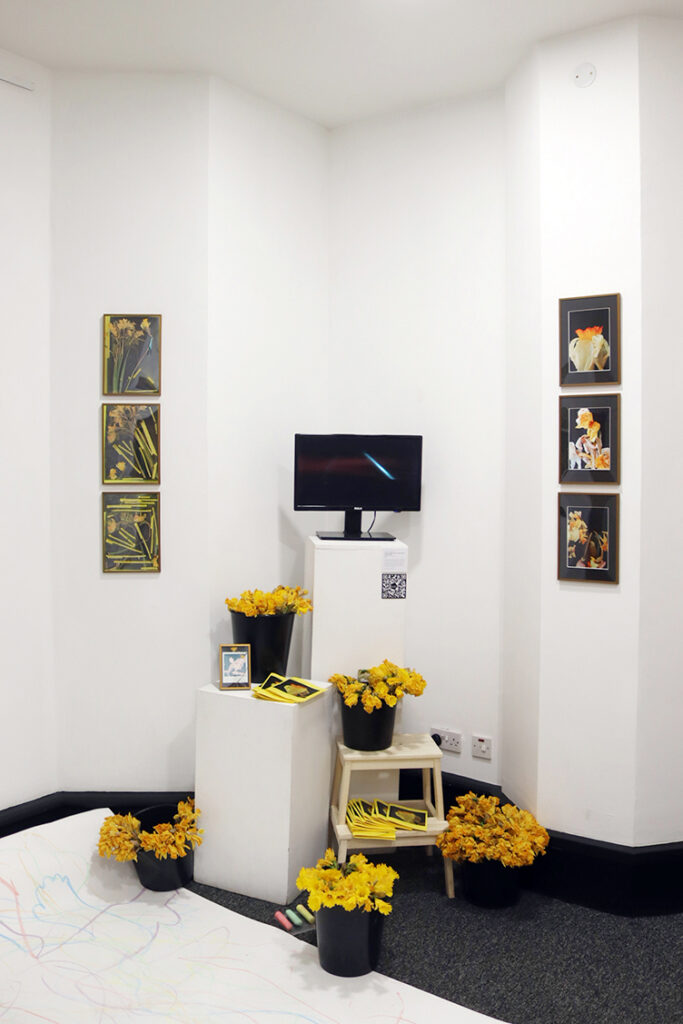
Six Foot Gallery is delighted to be hosting ‘corpus tenebras lux/sic : body map for vibrato’, a multimedia installation by Clare Archibald, exploring chronic illness, creative acts and connection, time, and archive. The work incorporates a short film, a text, mixed media scanography, photography, prints, and objects. It is a somatic invitation to participate that is both durational and generative. Regarding the participatory nature of the work, Clare states:
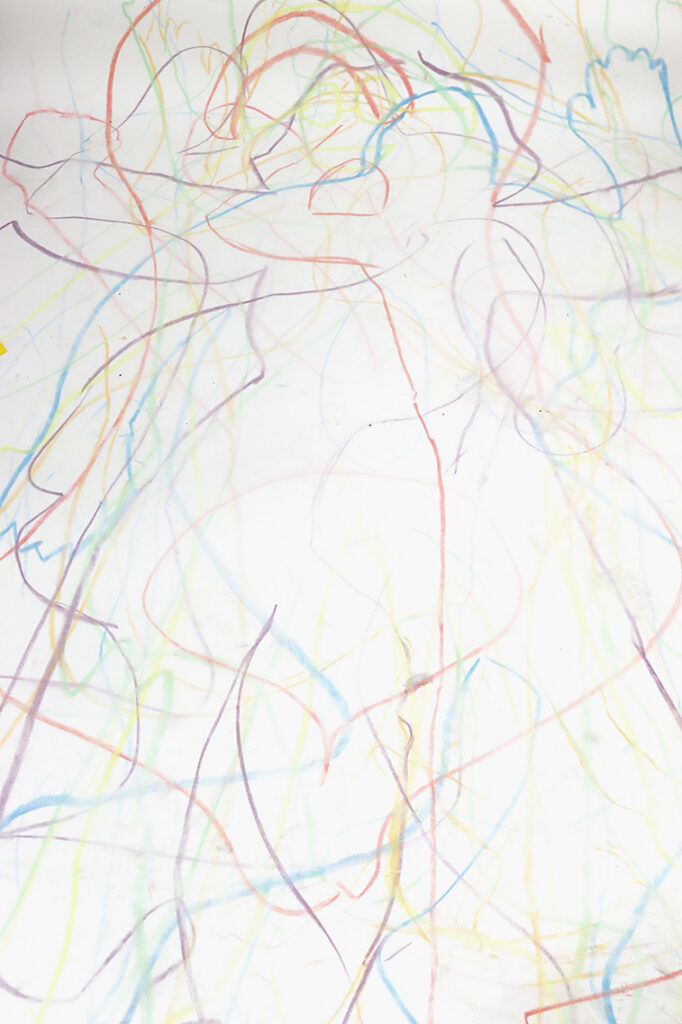
“What I really want, however I say it, is for you to lie or sit on or lean over the floor and draw an outline of yourself in coloured chalk. Everyone who does will become part of a new piece of work that I will make from the chalk imprints once this gallery run is over. A three week community of bodies thinking about their own and other people’s outlines. Borders of the mind, body and each other.”
Clare is a Scottish multidisciplinary writer and artist whose diverse, multi-layered experimental practice has transformation, connection, learning, encounter, situation, and reoccurrence as foundational concepts. The blur of imperfection, the disarray of unknown and the sway of repetition are fundamental. Her practice spans remote forest broadcasts, performance, walking/psychogeography, movement, curation/chairing of events/anthologies, stand-up, experimental weaving, puppet-making and more.
Great to have you with us, Clare. Can you tell us how your artistic journey started?
Like most people I’d imagine by daydreaming and playing with stuff as a child. I was extremely shy so spent a lot of time listening and observing and thinking quite a lot about what articulation means and what it is to express yourself as fully yourself. In my case that also involved being quite lazy and undisciplined with hankerings to be a writer in my teens and twenties not ever eclipsing just getting through life as a basic priority. I didn’t do art at school beyond second year, my only memory of which is designing a record cover (that I wrote a short story about decades later). When I was pregnant in my late 30’s I had a really strong almost physical urge to write but I repressed it because I knew that once I started It would be all consuming and that it really wasn’t the right time. Then when I was in my early forties and my daughter was at school it felt more doable. I got a cultural grant from Fife council to do a six week OU course, I did it for the two-assignment deadline and actually don’t recall looking at the course. You had to show community benefit, so I said I’d start a writer’s group, which I did despite having only written the assignment’s total of 1500 words. That’s maybe been my ongoing model for getting things done. Anyway, after a while I realised the group was stopping me from writing what I wanted to in terms of devoting energy to my own work, so I left.
I very quickly realised that I was interested in words doing more than being on the page, so I wrote and did stand-up comedy, poetry open mics, started collaborating with filmmakers, artists and musicians, and the wider public in terms of writing pieces in creative dialogue with sometimes large numbers of people unknown to me, started making solo work in sound, images and film which then further fed my interest in materials, objects and archive. I’m generally interested in making work that although perhaps intimate and thoughtful from a personal perspective has wider layers of others. Everything really is a process of interaction, learning and experimentation and exhausting the potential of that process and so I make multidisciplinary work on my own, collaboratively and collectively because different contexts or projects require a different set up. I’m particularly interested in the layers of place perhaps because as a container it holds all life and is endlessly fascinating.
I have what you might call a psychogeographic practice, a maligned word, but hard to find an equivalent as it’s more than walking. I wander round looking at stuff, taking pictures of stuff, noticing the intersections of the natural and built environment, time and motion, encountering people etc, and that eventually becomes something else. I’m old-fashioned perhaps in that I navigate new places by taking pictures of windows, debris and building sites that I find interesting and then use them as my map for getting around. That could also be applied to my artistic development. At 50 I got a postgraduate MSc with distinction in experimental filmmaking and media arts without having an undergraduate degree (although I went to university at 17, later dropping out) and no formal arts education so I always seem to occupy a between space of never quite doing things in the expected way. Which suits me.
Can you elaborate on the significance or symbolism of the chosen title of your
work?
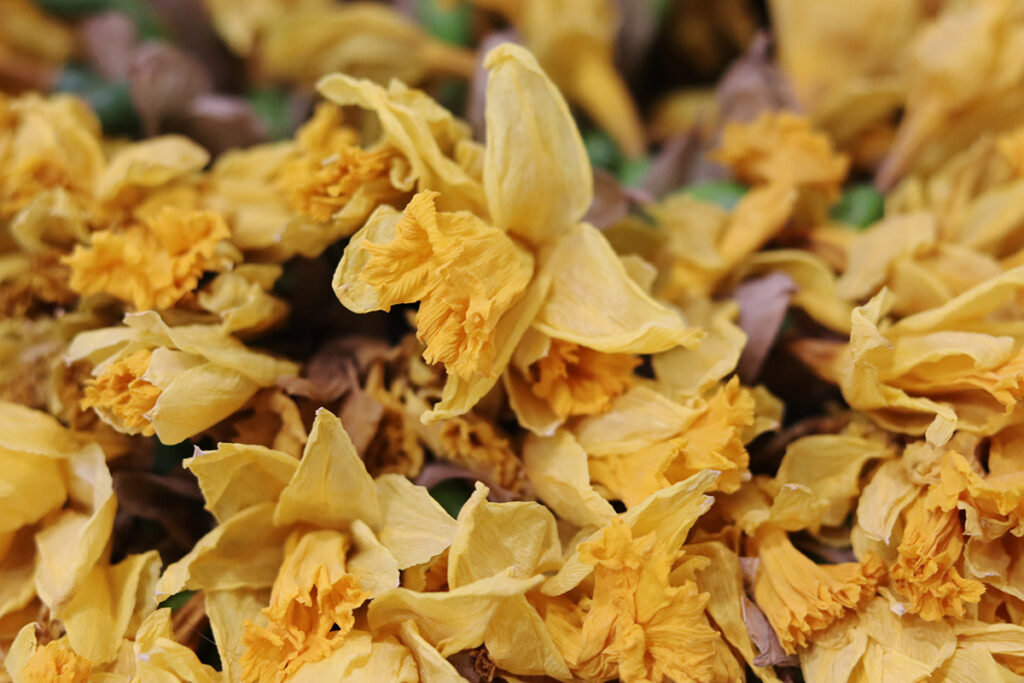
Dangerous question as I do like to elaborate. The title is actually two independently existent titles coming together – I explain this in the pamphlet accompanying the installation. Titles are hugely important for me, and often what I collect until I come across the other elements that make them meaningful or understandable to me. This is the first time actually that I’ve joined and slightly expanded (with the sic and very specific punctuation and spacing) two together like this. It felt right to do that because the installation brings parts of my archive together and is also paying a kind of homage to people such as Mimi from Low, the unknown person who owned the nightdress and the bodies creating the Glasgow body map. It is a fusion of the private and the public, of creative acts and connection. It is a ritualised offering in terms of the dichotomy of the title and the trinity within it. Corpus tenebras lux is working in different ways, as a reference to approximated language and learning and the capacity for precision and communication without perfection, the literal meaning of body, dark, light and the religious allusion to the Holy Trinity. One of which obviously is the Holy Ghost, and a reference to the Low song, the self that is incapacitated by illness and requires some other sense of spirit, and the ghostly presence of the unknown nightdress owner. I embodied this trinity in various ways within the work, three splits within the film, three slightly different versions of the pamphlet, three coat hangers, three columns of photographs and three lots of three framed works. All counter balanced with a single, small, framed Polaroid containing body, dark and light. The title also references the copper triangle within the film (and which I chose the frames and hangers in relation to). Initially I had thought that I would use the deep drone of the triangle as part of the sound but then felt that the vocal recorded far underground in the disused oil tanker reverb of Inchindown Tunnels was enough. Mainly though the triangle is serving as a taunt to no longer exist, a tantalising metal noose as an escape from the drone of illness. Perhaps I shouldn’t have told you that, but the bright yellow daffodils are there to transform the experience.
What emotions or reactions do you hope viewers experience when they see
your artwork?
I don’t really hope for anything other than they are not bored and maybe that they don’t think I’m a total wanker but even that I’m less bothered about. If it makes them stop and give time and attention and think or feel in some way and intuit that I have given thought and care to it, then I think that’s enough. I don’t really make work for affirmation; in fact, I find creatively insecure people a bit dangerous and exhausting on many levels. I do make work for other people in that I am very interested in their response, but I think that’s a different thing. I think a lot about how people can access art and creative development opportunities, but I don’t think there’s any point being prescriptive about responses as ultimately that’s not within your control. It’s selfish but as long as I’m happy with it then that’s enough. I do think a lot about intention and encounter and how work is situated. Encounter in terms of informing the work and then people experiencing the work. There are so many predetermined mindsets around this in terms of where things fit that I think it’s best to just ignore it and make what I want to but obviously there’s a cost to that decision at times. My practice probably sits somewhere between being conceptual and process driven and has so many endless layers and cross references that I would never expect anyone but me to get everything, and actually I’m more interested in that dance of revelation and understanding so anything that does resonate is, as they say, a bonus. Obviously I am human and therefore extremely pleased if people get what I’m doing but it’s not my goal.
The only exception to this is perhaps my body of work on expected neonatal death. I find it endlessly frustrating that work about any difficult experience whether it’s death or illness or whatever is seen through a grief or sympathy lens. I completely respect other people’s right to make work about grief or to situate work differently but that is absolutely not what I am doing. For me any grief is private and what I’m making public are the layers of the experience, the co-existent realities that I find genuinely interesting. I get so tired of the line ‘people never talk about these things’, often used I think problematically as a promotional tool, and I just don’t think it’s true. People do talk about it, people just don’t know how to, or choose not to, really hear what is being said. So, I prefer to say I have a right to talk about it, I am talking about it, but will people listen, and I think until we lose the ‘people never talk about these things’ trope any taboo just deepens as a result. The problem is that the endless onus continues to be put on those doing the talking not those who refuse to hear and until we rethink that it’s a meaningless soundbite.
How do you typically approach your creative process from initial inspiration to
the completion of your artwork?
Maybe clutter and time is the best description. I accumulate objects, images and a few words that I use repetitively in relation to them, thinking at some point I’ll do something with that and then just wait until it’s the right set of circumstances and I find out what it is that I want to do. I also walk and when I can’t walk I look and listen in a different way. My family would probably prefer I had a different, more minimalist approach. By waiting I also mean making because opportunities don’t just appear from thin air. I probably don’t believe that a work is ever finished, either of itself or the further layers and iterations that could come from it. Strangely perhaps I find this frees me up to not need or in fact want something to be perfect as then it has its own life. That said, although the blur of imperfection is what I love, I always have/need to have a very strong idea of/ feel for the overall rhythm of work whether it’s written, visual, aural or haptic. There has to be cohesion that also includes a bit of tension, and I think this comes from attention to detail and balance and spacing and for me that only happens outwith the vacuum of contained perfection. A deadline also helps.
Will your next project be a continuation of your current style or are you experimenting with something different? Can you share a glimpse of your next project?
I have several projects that I need to/want to finish this year before starting on anything new but I’m continuing to think, observe and accumulate in relation to my puppet that I made when living in Peru last year – his name is Pablo de Las Preguntas and I’m really excited actually to find out what I end up doing with him and Clarita (no relation), a doll that I made when in Colombia on a visa holiday from Peru – slightly hallucinatory with a parasitic infection and with a lot of help from a lovely woman in Medellin called Nora. I also have a project built around an abandoned flower factory begun when I was invited by Write Toscana to be their multidisciplinary guest in 2023 at their house in the hills above Barga that I’m really keen to go back to and finish off when time, money and circumstances allow. I also already have ideas about what to do next with the Six Foot installation. I think my style is actually to experiment in new ways but with an underlying interconnectivity to the work. So, it’s the same but different.
Are there any upcoming events or additional information you would like the
audience to know?
I have been away a lot the last two years so have a lot of catching up with myself to do. Things that are happening very soon are a pamphlet with No Roof, Only Sky, called this is not street photography, this is the dance of spectate. If I tell you that it includes a pastel drawing of me dangling off a New York construction site as Cagney and Lacey walk past underneath that’s maybe helpful, or not. There are lots of photographs of people in high vis jackets in various situations. It’s perhaps a ramshackle ode emanating from my enduring attention to high vis, window lurking, Shirley Clarke, motion, same but different, everyday choreography, the dissonant beauties of the built and the dismantled and cognisance/critique of the layers of hierarchy of private and public. It comes with an audio track that I recorded the base of when walking over Manhattan bridge from Brooklyn last year.
Then I have the first of two books this year for the Wilhelmina Barns-Graham Trust. I was funded by them to spend three weeks in Lanzarote last year, making work in relation to there as a place of significance to Barns-Graham and the development of her practice. The first book Unseen Formations: from Fife to Lanzarote with Wilhelmina Barns-Graham documents the work I’ve made with an accompanying essay and other forms of writing. The second is one I’m curating to highlight the practices of women/NB artists with an interest in place in Fife, Edinburgh and Cornwall, all sites of archival importance to Barns-Graham, with the aim of acknowledging the artists in their lifetime, and also giving archive access/book inclusion to those who perhaps don’t consider themselves to have a conventional art practice/background. I’ll be running experiential place-based workshops to support book submissions plus there will be an open call for sonic responses from women and NB people to my Lanzarote place score with accepted work being featured on the Barns-Graham Trust website.
In June, I’m taking ‘if trees were lone women what would they sound like’ to Rooted, a festival of people, plants and art in Aarhus, Denmark. The installation is part of my wider project exploring all women’s experiences of aloneness, darkness and wilderness. Previously it has been installed in Galloway Forest in 2021, with contributions from all over the world, last year in Peru, in the botanical gardens in Trujillo and so there’ll be almost 170 contributors being played from the trees over 2 days with whatever audio we receive in addition (in any form/language) from those living in Denmark.
Then my aim is to spend the second half of the year finishing/getting ready to finish at least two of three books, The Absolution of Shyness: an archive of self which brings together my work on expected neonatal death; hot coyote walks in the snowness of vast which moves from Germany to the Mojave desert, LA, New York and Peru and is perhaps slightly unhinged but I think it’ll work; then finally I want to archive all the Lone Women work in book form.
I currently don’t have a website as I deleted both my personal and Lone Women ones as they were hosted by Wix who support the genocide in Palestine. I really used my website as somewhere to store everything, as ongoing archive, and it was a sprawl of stuff akin to having a good rummage in a second-hand shop as I have amassed a huge amount of work despite my youthful laziness and lack of discipline. I was also perhaps slightly too trusting of AI and also human scrapers and so I’m rethinking how I want to do it and what I want it to be, and for whom. Eternal questions perhaps.
You can listen to some of Clare’s soundworks mentioned in the installation pamphlet on Bandcamp, including Birl of Unmap, Smooring the Fire, and can you hear the interim.
If you’d like to participate in Clare’s work, or to pick up a zine, stop by the gallery. OFFERINGS runs at Six Foot Gallery until 21st April 2026. Connect with Clare over on Instagram.
Leave a Reply