Written & researched by Alice Martin
Helloooooo Six Foot Gallery!
It’s been a while, hasn’t it. FAR too long.
Let me explain myself: in the Summer of last year, I stepped away from my position at Six Foot Gallery to pursue my MA in German Modernist Art History in London. Due to the workload and distance from the office, I was unable to contribute anything concrete to the gallery for a wee while. However! My MA is all finished up, and Fee has very graciously allowed me to come back as a writer (everyone say thank you Fee).
When Fee showed me the mood board for this year’s Summer Open Call Melting Point, I was intrigued. Not only because – as per – they were deeply visually inspiring, but also because in a beautiful twist of fate they related to what I had just been studying as part of my MA: cyborgs.
For the uninitiated, a cyborg is typically defined within the literature as a technologically enhanced or modified human. Cybermen, the Tinman, and RoboCop are all cyborgs to varying degrees. However, the cyborg is not just limited to science fiction, but is actually a concept which dates back well over 100 years, and has a strong cultural and artistic precedent globally. However, they tend to pop up most noticeably in the culture during periods of specific and significant unrest, not only as they appear to signify that unrest, but also as they articulate a specific social feeling about it. Think Robot Maria in Fritz Lang’s 1923 film Metropolis, in which the Modern Woman is represented as physically and spiritually taken over by the spirit of modernity – in the form of technologisation – and then spends the rest of the film intent on destroying the world as they know it. Although, as mentioned above, the cyborg was a globally significant phenomenon, I want to focus here on German Modernist depictions specifically, not only as I just got a degree in it, but because the presence of cyborgs in German visual culture was a product of its own kind of Melting Point.

It is hard to overstate how shit things were in Germany at this time. They had just lost the First World War, and believed that they were done dirty in the Treaty of Versailles. The Treaty had essentially asserted that the Germans were largely responsible for causing the war, and as such owed reparations to countries across the world. The human cost was also significant, with over a million Germans dead, and hundreds of thousands of men returned from the war permanently physically disabled and/or psychologically traumatised. It was not much better for women, with a reported 100,000 women in Berlin alone who were forced into sex work to make ends meet.
To make matters worse, inflation happened, which saw the rate of inflation rise to 75,000,000,000% in less than five years. A loaf of bread, which would have cost 29 pfenning in 1914, cost 1,200 reichsmarks in the Summer of 1923. By November of the same year, the loaf would have cost 428 billion reichsmarks. And then, as if things weren’t bad enough, the global depression came along in 1929, which undid any economic progress the Germans had made that decade.
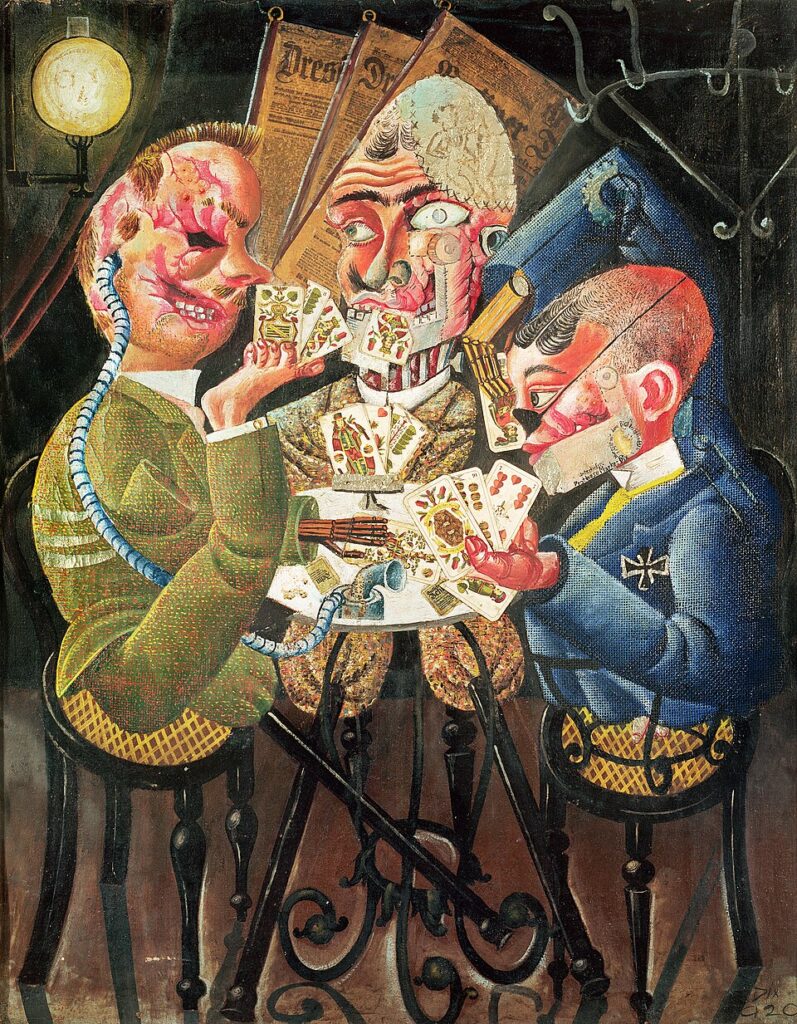
Like I said, it was shit. Unsurprisingly, this political instability was socially disastrous, resulting in huge waves of popular disappointment and discontent. Artistically, this manifested itself upon the human body, or more specifically, the male body. Now, this artistic representation of the male body as symbolic of society was not new, in fact, the German government frequently weaponised the male body in propaganda images. These propagandic tools tended to focus on the body as a symbol of the strength of German society, with figures appearing muscular and physically imposing. However, many Modernist artists, mainly Dadaists, decided to weaponise this symbol to illustrate their own gripes, and subvert the “muscly man” motif along with it. In its place was the cyborg. This materialised in two distinct ways in the prominent visual culture. The first way was to depict man as partially technologised. Chiefly appearing in works by artists like Otto Dix, the partially technologised man was an ex-soldier, whose mechanic transformation was the result of physical harm or disability. In works like The Skat Players (Die Skatspieler) (1920) by Otto Dix, for example, soldiers, still in their military uniforms, have been technologically augmented to account for loss of limb: the right-hand and central figures have had their jaws replaced with metallic hinges, and the left-hand figure has a tube coming out of what used to be his ear, attached to a small speaker perched on the table to pick up the conversation.
The other way this “cyborgification” occurred in art was through a total physical and mental transformation, as exemplified in works like Republican Automatons (Republikanische Automaten) (1920). Work like this reflects a general alienation towards the government, and illustrates a widely held contemporary sense that bureaucrats were simply puppets of a bourgeois class.

To state the obvious though, consistent in both cyborg “types” is the sense that human technologisation, either real or symbolic, is inherently dehumanising. Not only that, but it is a deeply humiliating and emasculating process, which alienates their subjects from selfhood. Also significant in these representations is the way that modernity, as symbolised by technologisation, is depicted as bad. By extension, this representation reflects a deeply rooted fear of the future, or more specifically, the future that modernity would create.
Running through images like these is a sentiment we could easily expect from an artist who had just seen the pure destructive power of industrialisation on the front lines of war. The technological advancements that were intended to empower and strengthen their nation in war had the adverse effect.
However, there is also a secret third type of cyborg in contemporary visual media which is usually left out in discussions like this one. And that is the empowered soldier-male.
These are best exemplified in the statues and murals of Oskar Schlemmer. Most famous for his work in theatre design and as a teacher at the Bauhaus school, Schlemmer had, like many artists at the time, fought in the war, suffering a leg injury at one point, before suffering a mental breakdown which got him discharged from the army. When he eventually made it to the Bauhaus, he had already started development on a series of sculptures and murals, which he had reportedly viewed as preparatory work for famous theatre show, the Triadisches Ballett (1912-1922), which you can (and should) watch here. However, when you look at these sculptures and murals as standalone work, they tell a bit of a different story, especially when we consider them in the context listed above.
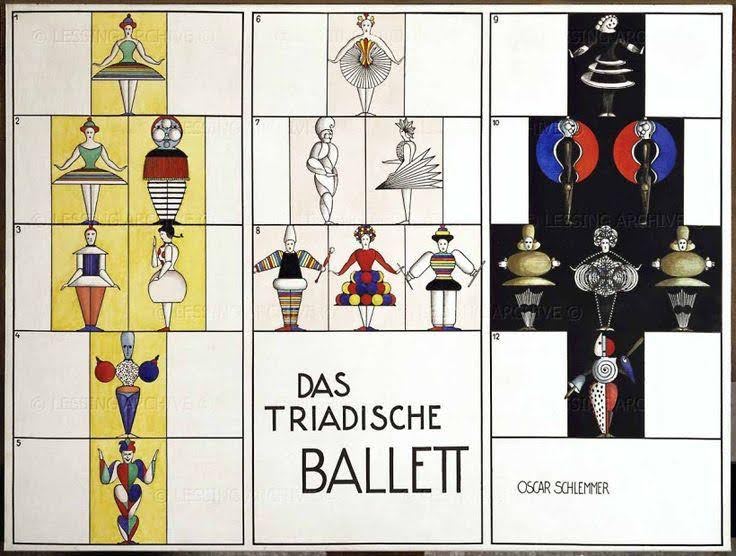
Most of the sculptures picture human bodies or faces, which have been technologically augmented, either through a layer of metallic armour, or through a kind of machinic compartmentalisation, whereby different body parts are delineated by what resembles wires.
In essence, they are not dissimilar to the examples listed above. The statues are contorted, augmented, and dehumanised, in line with The Skat Players and Republican Automatons. However, in these examples, their technologisation is not the cause of their pain, but rather sustains them through it.
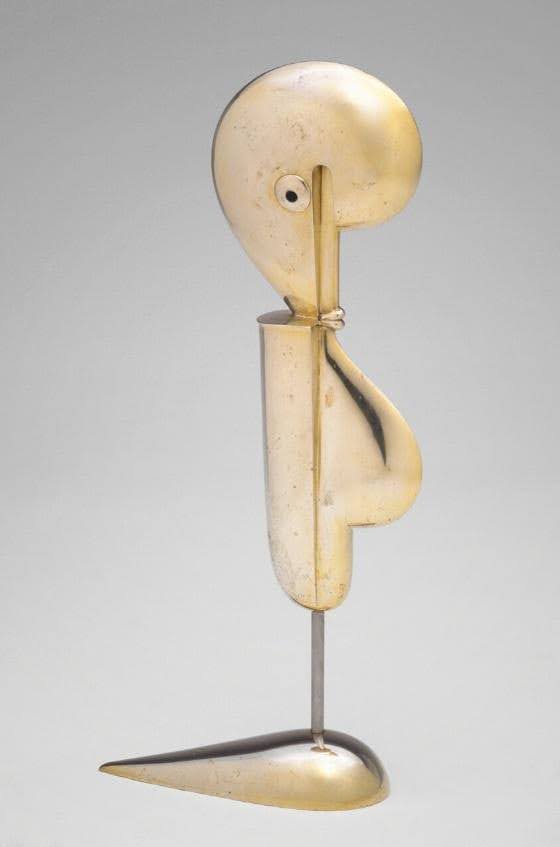
In Abstract Figure (Abstrakte Figur) (1921), for example, the body it depicts is clearly physically distorted, and its face is absent from its head. However, through the technologisation of his metal coating, this “armour”, he is protected, fortified. He is a solder, but unlike in The Skat Players, his time in – and brutal physical experience of – military service has been empowering, not debilitating. The same can be said for works like Grotesque Abstract Figure (Groteske Abstrakte Figur) (1923), which simply depicts a head, contorted out of proportions. Although this is slightly less obviously a soldier, it still captures this sense of physical and emotional alienation consistent with other pieces of this “type”.

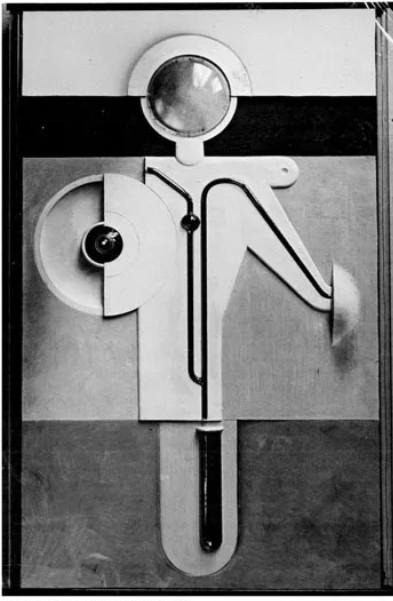
Another similar example is Relief in Plaster and Glass (Relief im Gips und Glas) (1923), which similarly represents the military male as a cyborg. However, Schlemmer seems to have graduated from his earlier depictions of the post-war body as broken and contorted, and now creates a fully-realised – and fully idealised – cyborgian soldier-male. He is entirely dehumanised, with his head and body reduced to blank shapes, unable to act autonomously and primed to control. He is built to serve, with his body frozen at permanent attention, holding a shield in one hand and a sword in the other. He is also strong; although, as the title suggests, he is made from plaster and glass, much of his body is rendered to look like Bakelite, an incredibly durable plastic which was used for both domestic and military purposes. In this sense, Schlemmer shapes an ideal contemporary soldier.
What these figures of Schlemmer represent more broadly though is an alternative attitude towards modern war, and towards modernity itself. Now, to us, this shift in the cultural understanding of the impact of war from one of pity or disillusionment to one of motivation seems quite bootstraps-y. It seems alien to us now that the experience of trench warfare would be understood as anything other than traumatising. However, at the time it was pretty inspiring stuff. Modernity was increasingly becoming associated with a utopian outlook, and the technological advancements made possible by largescale warfare were viewed as the building blocks to a brighter future. Schlemmer himself talks about the utopian facet of his sculptural work at length in his diaries. In one entry from June 1922, he talks of a dream he had, stating “I saw everything: a perfected glass culture, no longer industry, civilisation – the glass pictures: chiselled, polished, colourful-anatomical-metaphysical man – it was glorious! feeling: what should I do? do nothing? begin to make it a reality? I have seen the future.”
From this quote alone, the key difference between Schlemmer’s cyborgs and that of his contemporaries is clear: while everyone else was thinking about the present, Schlemmer looked into the future. To be sure, he felt that art had a predetermining quality to it, writing in 1923 that “art anticipates the events in the exterior world,” and in his sculptural work, we see what that potential “exterior world” may look like. The machinery which had wrought such destruction to the figures of the Dadaists was, for Schlemmer, a look into a utopian future.
You can find Alice on her Instagram @_aliceelmartin.
Leave a Reply