Once again Scotland’s art school graduation season is upon us: glasses are brimming with complementary prosecco, caps and gowns donned, and giddy family and friends have travelled far and wide to celebrate their loved one’s accomplishments. There is a collective exhale as years of hard work and late nights finally pay off and artists across the country begin their metamorphosis from undergrad to postgrad, the glittering new alumni of their institutions.
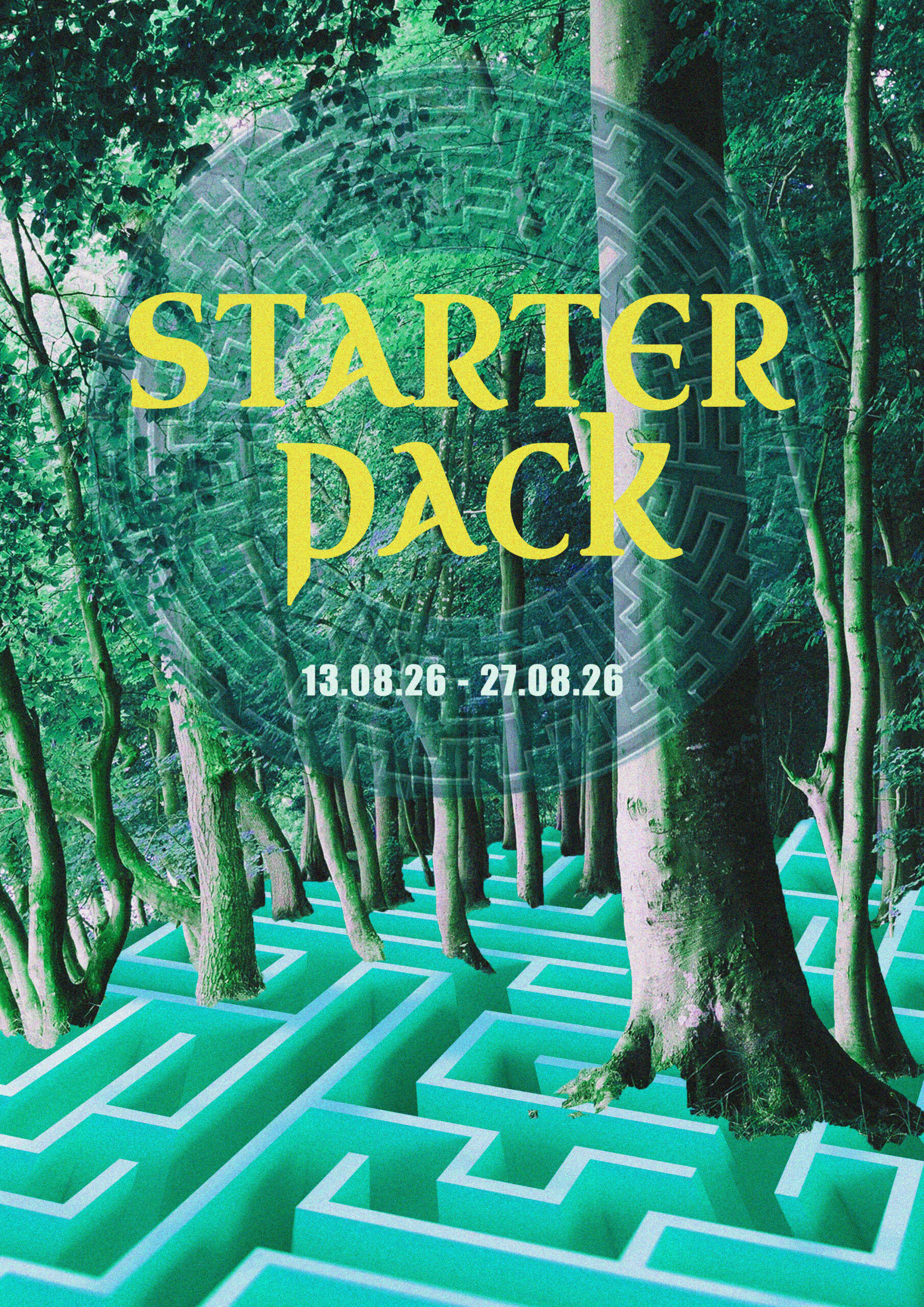
Starter Pack returns this summer to provide a platform for Scotland’s emerging artistic talent. As an artist-led organisation, we offer graduates the soft landing needed for the next stage in their careers. It’s a fresh deadline to work towards, a chance to show work in an established gallery with a diverse audience, and, at its core, an opportunity to connect with their community.
For this year’s exhibition we’ve invited twenty three artists exhibiting work across a range of disciplines, and we’re delighted to welcome them to SFG.
ANNA MACKENZIE | JOE GELDER | ABIGAIL STROTHER | NATALIE LOUISE GARVEY | SHUO YANG | ALLEGRA LAVINIA FLEUR | LISA GROENENDIJK | RUTH BABINGTON | LUCIE DOREMUS-COOK | EMMA CONNAH | FIONA LIVINGSTONE | SAFFRON CUNNINGHAM | RUTH YEE | BENE VETTESSE CRUDEN | OLIVIA RUNCIMAN | ABBY ROGERS | DENISE HORN | JESSIE BLUE ELLIOTT | ROSIE BOYCE | EMMA BRADLEY | | EMMA NEILL | SUNNY MIN | WILLA BAKER WILBRAHAM | AMY BLACKBOURNE
Works available to buy from £85
Please direct all sales enquiries to sixfootgallery@gmail.com
Participating Artists
ANNA MACKENZIE
Anna Mackenzie (born 1979, Liverpool) began her career as a footwear buyer before starting a family and having the opportunity to rediscover painting. On both the Figure and Painting courses at Leith School of Art she has developed her painting practice, creating large scale works drawing on themes of childhood experience, parenthood and neurodiversity.
JOE GELDER
Joe Gelder (b. 2003, Preston, United Kingdom) is a photographer and recent graduate from fine art photography at The Glasgow School of Art. His practice explores the relationship between human presence in the landscape and the longstanding, neolithic forms of the Scottish environment. Informed by the land art movement, the agency of Joe’s work is often handed in favour of the landscape, and the sites he embeds himself in form the context of the outcomes. The theory of phenomenology is key to Joe’s practice, where bodily presence and duration help shape the outcome of his documentations. Working with analogue photography techniques, Joe’s outcomes explore the natural texture, form and sculptural qualities that appear through prolonged interaction with a landscape. Growing up just below the Lake District, Joe’s work has always been concerned with the natural landscape and how one can perceive it.
ABIGAIL STROTHER
Abigail Strother is a multi-disciplinary artist, often with a focus on drawing and printmaking. Her practice is rooted in her physical location – built completely around in-person field work and tactile connections to the environment. She pulls inspiration from native environments, folklore, and nostalgia through a naturalist and feminist lens. Primary research is central to her practice, collecting this in the form of foraging, audio recording, photography, film, rubbings, and on-site sketches. The symbolism, language, and representations of flora and fauna are key to her work and she explores narratives between them. She takes journeys to specific sites, locating certain historical ancient trees, taking the moment to spend time in the environment experiencing their presence and learning how they interact with the surrounding area, developing their own ecosystems. She shares these often forgotten and overlooked parts of heritage, as a memorial for the decline of these environments, but also as a revival in a political approach.
@abigailstrotherart | abigailstrother.cargo.site
NATALIE LOUISE GARVEY
Natalie Garvey (b. 2003) is a painter living and working in Glasgow. She is trying to replicate her lived experiences of suburban Scottish landscapes, doctors, depression, coming of age from a hospital bed, and living with the consequences of these things, using the body as the vessel. Her paintings are informed by Scottish social history; from the Witch Hunts to the Ice Cream Van Wars to Paisley’s industrial past, as that is where she is from and grew up. These paintings come from her most recent body of work that became her degree show at the Glasgow School of Art, where she studied Painting and Printmaking. Her practice not only includes painting but drawing and printmaking are both crucial ways of making for her. Many ideas, compositions and feelings come from automatic drawing informed by dreams and consumed media.
SHUO YANG
Shuo Yang’s work, Blood Land, operates as a conceptual framework for understanding home as both a material and symbolic construct. The term invokes land marked by the corporeal traces of birth and ancestry, while simultaneously signifying the formative environments of childhood and youth, where subjectivity becomes irreversibly situated. Through a research-led journey along the Scottish coastline, the artist undertakes a process of locating this ‘blood land’. Encounters with stones, decaying wood, ruins, and perishing organisms serve as critical prompts to re-evaluate the entangled relationship between individual and place. While the notion of ‘blood land’ initially suggests violence and historical sedimentation, the project ultimately reconfigures it as a site of introspection, foregrounding processes of self-acceptance, forgiveness, and the negotiation of change.
ALLEGRA LAVINIA FLEUR
Drawing is central to Lavinia Fleur’s practice, offering a space to explore the subtleties of our daily lives. Drawing from life, she continually records her surroundings in sketchbooks, creating sketches in watercolours, gouache and calligraphy pens. Through her work she explores moments which are seemingly unremarkable, but through this she touches on the intimacy and complexity of existing in our bodies. These drawings are then brought back into the studio and taken apart, reworked and combined with memories, literature and dreams, subtracting the reliability of the narrator. Collaging canvases, bright colour pallets, and murals which expand out from the canvas, Lavinia Fleur creates works which sit within a dream-like space offering moments of reflection, peace and intimacy.
@allegrars_art | allegralaviniafleur.cargo.site
LISA GROENENDIJK
Lisa Groendendijk (b. 2002) is an artist from Stornoway, Isle of Lewis, currently based near Glasgow. Her practice explores the underlying stories, unsettling energies and moments in time which exist within rural Scotland and its landscapes. Her practice involves a form of storytelling in which she can expand upon these ideas through her work. She feels very connected to the rural landscapes within Scotland, specifically to the Isle of Lewis where she is from. The memories of these landscapes are important as they act as a set for her paintings to unfold upon. She is interested in the traces of the past which haunt and linger within these landscapes. Her work acts as a window looking into specific places and moments in time, which become memorialised within her paintings. Through looking at her work, she feels she can revisit these places, and hopes the viewer can be transported there too.
@lisagroenendijk.art | lisagroenendijk.art
RUTH BABINGTON
Ruth is a Glasgow based artist and a recent graduate from the Glasgow School of Art. Her work reflects and explores the properties of colour, with the aim to disorder compositions of images that already exist into a new and structured system. What is revealed during this process is a weaving together of what you expect to see and what you did not. Her focus is on how colours interact with each other in creating a new, rhythmic image that celebrates the intricacies of colour relationships rooted in traditional and contemporary colour theories. This relationship with colour stems from her experience with hearing loss and the peace found in controlling her visual sense, where sound is illustrated and not heard. This system she has created allows for a visual focus and a personal physical immersion into the act of painting where comfort is found in repetition of a physical and mindful act. Where the spirit can be fulfilled in a communication of colour alone.
@ruthbabington.art | ruthbabingtonart.co.uk
LUCIE DOREMUS-COOK
Lucie Doremus-Cook’s practice examines the liminal spaces between place, language, memory, and perception. Centred on the Möbius strip as a recurring conceptual motif, her work dissolves binaries such as inside and outside, subject and object, proposing instead a continuous, entangled experience of being. Working from remembered landscapes: fields, floodplains, and sand dunes associated with childhood – she uses writing as an integral part of her process, allowing language to mediate memory before it is translated into paint.
Shaped by a bilingual upbringing, Doremus-Cook’s work considers displacement, mistranslation, and the fragility of communication, exploring the productive ambiguity that emerges when meaning begins to slip. Her materially driven practice embraces processes of concealment and revelation, with images surfacing through layered paint and intuitive mark-making. Reclaimed wood, paper, and inherited textiles extend the temporal resonance of the work, creating paintings that inhabit the thresholds between memory and landscape, presence and absence, permanence and dissolution.
EMMA CONNAH
Emma Connah is an artist based in Aberdeen and recently graduated from Gray’s School of Art. Her work explores the minimal nature of drawings through exploring identity, with her special interest in moles across the skin. The simplicity of her drawings draws from the paper that she uses, where the paper itself enhances the drawing. Her current paper of interest is a handmade Khadi cotton paper; this texture of paper allows for the lines to be pushed further. The minimal approach to her process allows for the mind to relax as the repetitive circles create an ease of mind. While it becomes obsessive, not only is the work at peace but she is as well.
@emmaconnahart
FIONA LIVINGSTONE
Fiona Livingstone is an Aberdeen based artist whose works mainly with oil paint and more
recently, coloured pencil. Her work takes inspiration from her own lived experience and considers how trauma can shape identity and emotional response. Her recent body of work has explored themes of power and control, considering how unhealthy power dynamics affect us as individuals and influence our perception of both ourselves and the world around us. She uses animals as a motif throughout her work as they act as representations of herself, further adding to the idea of powerlessness and lack of control. Strings are also used as symbolic imagery throughout her work, acting as subtle suggestions of interconnection between the powerful and the delicate. Additionally, she considers her artwork to be a form of feminist praxis, considering how the issues of power and control shape the lives and experiences of women.
SAFFRON CUNNINGHAM
Saffron Cunningham is an artist that focuses on the in-between. Choosing to paint run down spaces that have succumbed to the foliage around them, creating a sort-of purgatory. The paintings draw you in with the sheer darkness which is enveloped by the cascading light coming from outside. Her work is intentionally made to make you feel as though you are the only person left to walk the Earth, carefully exploring each unfamiliar environment to uncover what it has become without our intervention. Her paintings allow you to exist on an entirely different plane of existence alone, silencing all external sounds around and allowing you to ruminate in that silence. Saffron is currently completing her Masters in Fine Art at Gray’s School of Art, where these themes continue and grow to completely encompass the space, widening this world of decay and regrowth.
RUTH YEE
Ruth is originally from London but now is based in Edinburgh. She works in oil and is in her final year at The Leith School of Art. Her paintings explore human connection and celebrating the ordinary. Her practice is rooted in finding meaning in familiar moments and shared experiences that often go unnoticed. Working within a limited colour palette, the she creates a sense of harmony that allows the relationship between tightly rendered passages and looser, more expressive marks to become more pronounced. This balance between precision and spontaneity mirrors the way memories and emotions are experienced – some details remain vividly defined, while others dissolve into suggestion. Although each painting is a portrait of an individual each piece invites viewers to recognise something of themselves within the work. Her work encourages a moment of reflection, reminding us that the ordinary is often where our most meaningful experiences are found.
@yee940
BENE VETTESSE CRUDEN
Bene’s practice is rooted in a fondness for interior scenes and a fascination in the capturing of atmosphere and light. He draws and paints moments which feel subtly striking, where a soft sense of drama is present. These scenes sometimes include figures nestled in the environment of the home. His process involves drawing, photography, and occasionally collage which is used to distort the shape of the image. An important element in the practice is repetition, with pieces being drawn numerous times, sometimes in different ways, experimenting with colour, composition, and size. These processes usually lead to painting, where the experimentation of the preliminary work informs the finished pieces.
OLIVIA RUNCIMAN
Olivia Runciman is an emerging artist, producer, and curator who is intrigued by mark making, materiality, and the boundaries of abstract painting. Heavily inspired by the abstract expressionist movement her work orbits around the changing qualities of colour, composition, gesture, and movement through works on silk, paper, and raw canvas. Her practice involves working in a loose, reactive way allowing unplanned and spontaneous marks to appear. Led by a concentrated focus on process and materiality, her exploration of painting and expanded painting poses the question ‘what is at the core of abstraction?’.
ABBY ROGERS
Abby Rogers is an interdisciplinary artist born and based in Glasgow. She is devoted to a practice that combines illustration, installation, and film. Her work is rooted in storytelling and anthropomorphism and is fuelled by their passion for global issues, including human and environmental rights, shaping the themes and messages she explores through her art. Using imaginative characters, landscapes, and narratives, Abby depicts reality as she feels it, not as it truly appears, distorting and creating new worlds that reflect her innermost thoughts and emotions, using materials not only as a means of making but also as a force to push the message her work carries. Her ability to tap into different mediums allows her to communicate across multiple platforms to audiences and through various environments and means. Her process is intuitive and impassioned, embracing ambiguity and a surrealist approach, inviting viewers to explore a new world of imagination and visual metaphors.
@abbyart.lss
DENISE HORN
Denise Horn has recently completed her second year studying Painting at Leith School of Art. Her practice explores everyday life and the experiences of women through painting and collage. Working mainly in oil paint, she builds layered surfaces using handmade papers, repeated patterns, and expressive marks. Her background in stained and fused glass, alongside a love of textiles, continues to influence her use of colour, texture, and light. Alongside her studies, Denise works with Adoption UK Scotland, supporting adoptive families. The people she meets through her work, together with her family, friendships, and everyday experiences, all inform her practice. A recent return to Marrakech, 26 years after her first visit, has influenced her recent work. Revisiting the city with her teenage daughters prompted reflections on culture, women’s lives, and how perspectives change over time. Through her paintings, Denise explores these ideas, finding meaning in ordinary moments and shared experiences.
JESSIE BLUE ELLIOTT
Jessie Blue Elliott is a multidisciplinary fine artist based in Northumberland. Her process uses the tactility of oil paint, charcoal, or pencil to render intimate details of sensory memory. By critically analysing the act of looking, Elliott utilizes the biases and flaws of human perception to translate memories as experienced by an unreliable narrator. Her work draws parallels between sporadic natural phenomena; exploring the shared form of body and landscape.
ROSIE BOYCE
Rosie Boyce is a multidisciplinary artist born and based in Glasgow. Working across painting and photography, with oil painting at the centre of her practice, she explores memory, intimacy, and the emotional resonance of everyday life. Using personal photographs as a place of departure rather than an endpoint, her paintings transform familiar images through colour, gesture, and material process. Existing between representation and abstraction, the works resist a fixed narrative, instead inviting viewers to inhabit the uncertainty between remembering and imagining. Grounded in personal experience yet open in meaning, Boyce’s practice reflects on the people, places, and fleeting moments that shape how memory is constructed, suggesting that the ordinary can carry profound emotional weight.
EMMA BRADLEY
Emma Bradley is an artist based in Edinburgh and a recent graduate from Edinburgh College of Art. Working primarily with ink on paper, her practice explores the relationship between urban landscapes, the natural world, and the traces of human presence within changing environments. Drawing from aerial perspectives, satellite imagery, and the visual language of maps, Emma creates layered compositions where cities, landscapes, and human structures begin to dissolve into abstract patterns. She is interested in the movement and rhythms of people within these spaces, and how human presence leaves behind visible traces within the landscape. Through the unpredictable nature of ink and fluid materials, Emma allows the spontaneity to guide the development of each work, embracing moments of chance as the ink spreads and creates unexpected forms. Balancing abstraction with recognisable structures, Emma’s paintings invite viewers to look more closely at familiar landscapes and reconsider how they are experienced from above.
@emmalouise.art | tinyurl.com/emmalouiseart
EMMA NEILL
Emma Neill is a fraternal twin who works primarily in oils, she lives in Fife and studied Fine Art at DJCAD. She is inspired by symbolic pairing and the ideas of duality, subtly reinforcing the connection with her twin is something she carries with her at all times and not just when they are together. She has this commonality with other twins, as she understands the powerful and unique bond built through sharing lifelong experiences that others may not fully understand. Exploring the connection between two figures within her paintings allows the viewer to relate to her work through their own relationships. She often includes symbols or imagery that only her twin would recognise, this creates intimate, emotionally charged pieces. A lot of her embeds symbolic imagery becoming a visual metaphor for the invisible connection between twins and how two different people can echo each other’s emotions, identity, and destiny.
WILLA BAKER WILBRAHAM
Willa Baker Wilbraham’s practice is self-referential, with her nude body serving as the primary subject. It centres itself on themes of female auto-eroticism and is developed through both direct observation and photographic references. Willa is interested in how the female nude body refigures itself when looked upon. Theoretically, she alludes to Feminist politics and aesthetics, oscillating between subject and observer and creating a persistent tension throughout the work that permeates into its visual language, existing between beauty and discomfort; the material dark, the form seductive. Willa plays with ways of dissolving the body: the appropriation of Cubist techniques and angular figuration becomes an act of resistance against the treatment of women’s bodies as mutable objects. Through this reimagination of perspective, distortion and fragmentation, Willa reflects on contemporary sentiments of visibility. She is also interested in how absence can function as a structuring presence, and in the interplay where meaning slips between revelation and concealment.
AMY BLACKBOURNE
There is a curious space between earth and the spiritual realm, between the seen world and the unseen world. Amy Blackbourne works across mediums that float between 2D and 3D to allude to this further dimension. She is based in Glasgow, from Northern Ireland. Thus, her practice is positioned between city, sea and open country, with her sketches and writings of these spaces forming a visual framework to experiment over. Through a variety of methods, Amy leans into the ambiguity of familiar city and landscape shapes like those of houses, motorways, trees, birds and stars. Amalgamating their motifs with automatic mark-making and text, she depicts the invisible space, creating environments that feel both familiar and vastly unknown, and employs physical metaphors in her practice, inviting a viewer into these places with light humour and cultural references.
@amyf_arts | amyblackbourneartwork.cargo.site
SUNNY MIN
Sunny Min is an artist who primarily uses writing and sculptural methods, alongside experimentation with various media such as rituals, collecting, simplification, and observation, to create works centred on the act of dedication: dedicating one’s time and space to found or lost entities and thoughts.
Here’s to the small, mundane moments within life.
Here’s to the writings and sayings I came across.
Here’s to the ones who were left behind.
Here’s to the lost objects.
Here’s to the lost loved ones.
These examples are the core inspirations of where her works are unearthed from.
Starter Pack, our annual graduate showcase, runs at Six Foot Gallery until Thursday 27th August.