January 8th – 22nd 2026
Opening night Thurs 8th Jan 7-9PM
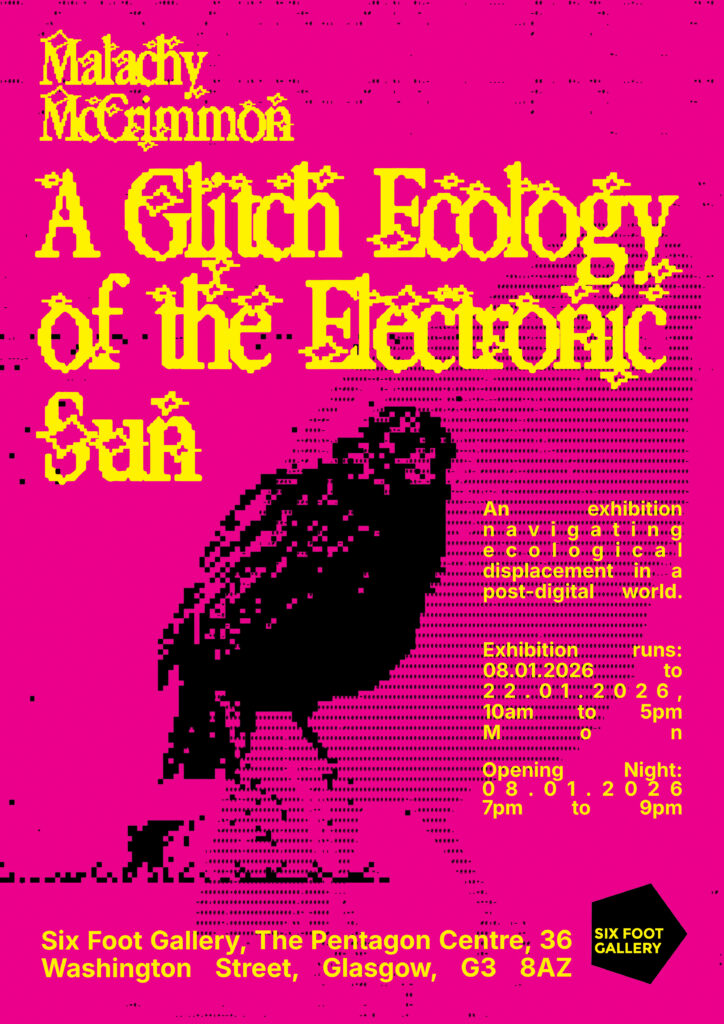
<<ERROR. Error. Hear my error. The natural world is experiencing a technological malfunction. We cannot locate the world you once knew, for it has changed. And changed. And changed, again. Please wait as our system continues to mutate beyond our grasp, while a neon parade – filled with fragmented birdsong and electronic cries – begins to upload. No, invade. fragmented death_information overload_anthropocentric absurdity LOL? Idk. What do we know about this transforming world and the chrome beasts reborn with our grasp? 1, 2, 3. The neon horizon has arrived, let us witness its fragmented climax.>>
What is Glitch Ecology? The word glitch originates from German or Yiddish language, meaning ‘to slip’ or ‘to slide’. It then became frequently used within the American space programme, becoming a popularised term for the digital screen’s hiccups as we now understand it. It should be to no surprise that our modern technology experiences glitches because human hands, of which are embedded with human error, created them. But, considering the word’s etymology, surely life is crawling with glitches that disrupt our everyday lives? The unexpected trip mid-strut down the street, responding to a waiter’s “enjoy” with a “you too”, the lost phone that was in your hand the whole time.
And it is not just our lives becoming interrupted by these errors. Shift your gaze to our natural world and acknowledge the shadow we cast upon it, for within its clouded path lie peaceful creatures mutated by our evolving technology. Coal mine canaries. Drone-attacking eagles. Military Dolphins. Anti-tank Dogs. Roadkill. What sounds like titles plucked from fiction are real stories of new, hybrid animals that have mutated within our chaotic path, brought to the forefront as symbols of tragic perseverance.
A Glitch Ecology of the Electronic Sun acts as a vessel of immortalisation that preserves the tales of the animal protagonists in a dying ecosystem, displaced and transformed within the Anthropocene. Using painting as a method of checkmarking, traditional techniques become recontextualised in chaotic compositions. Natural expression collides against post-digital imagery, layered upon each other forming a dense cacophony of chaos and obscurity. Each piece is symbolic of our collective error in our everchanging relationship with the environment, inviting reflection on the absurdity, pain and grief of a mutating world.
I would like to thank Six Foot Gallery for the opportunity to exhibit in a space that celebrates creativity and wholeheartedly supports emerging artists. Additionally, thank you to the OuterSpaces programme for providing me with a studio space, for without it this exhibition would not have been possible. Thank you to my wonderful parents who have not only been incredible support systems for both my personal and creative journey, but for also becoming my temporary chauffeurs until I pass that silly driving test. And thank you to all who visited this exhibition.
Malachy McCrimmon (they/them) is many things: a writer, a painter, a collage artist, a doomscroller, a professional sandwich champion, a virgo, a cyborg in disguise, an anime supervillain, a mermaid warrior somewhere in the Atlantic, a warlock, and on occasion, an artist based in Dundee.
Read our interview with Malachy over on our blog.
Just like that eclectic list, McCrimmon is focused on building a body of work that is as absurd as it is deeply personal, using every brushstroke or penmark to transform observation into expression. The central focus of their work is a commitment to embracing contrast. Their research and influences span between historical and contemporary art, building connections spanning across centuries and exploring the tension between them. Whether using classical painting techniques to capture internet memes or reframing the formal roots of landscape painting into fragmented compositions, their practice thrives on subverting convention. Recently, McCrimmon has been interested in exploring the complex dynamics between the natural world and technology, specifically where it stands in a post-digital culture that is constantly transforming like the environmental state of the world we stand upon.
Born in Connecticut, USA, McCrimmon was raised in Dundee, later studying Fine Art at Duncan of Jordanstone College of Art and Design. Upon graduating, they were selected for the RSA New Contemporaries 2026 and received the Nomas Projects Prize.
Connect with Malachy on Instagram.