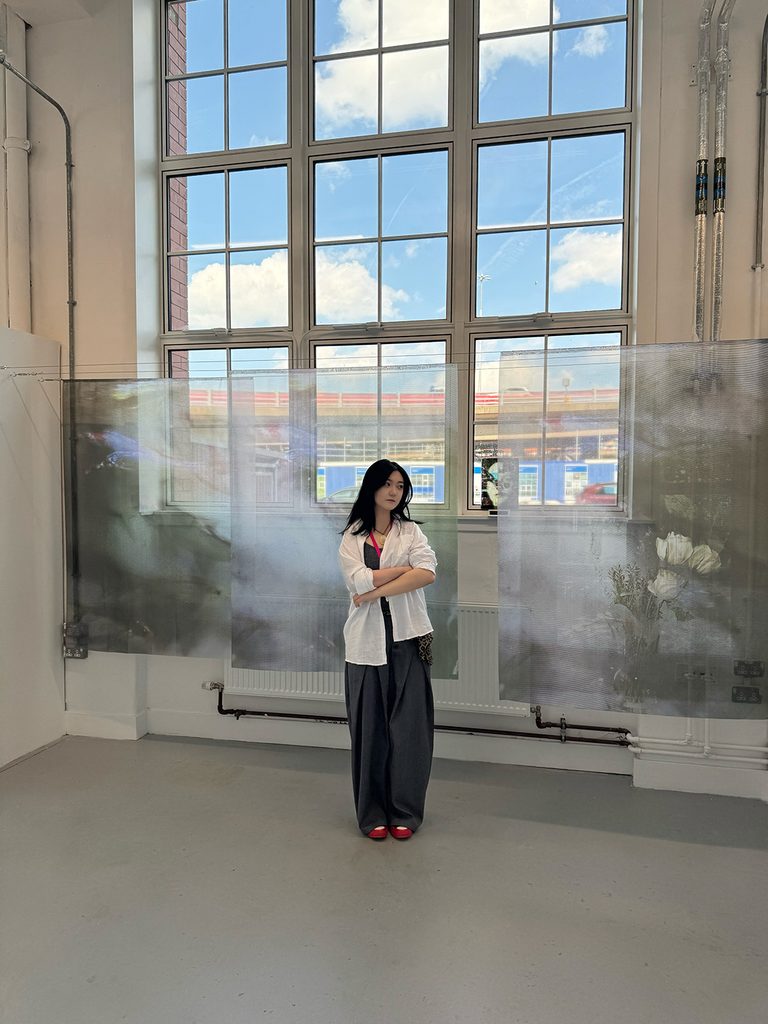
Demi Gao is a visual artist currently based in Glasgow. Her practice moves across painting, mixed media, screenprint, and digital image-making, taking grayscale as a methodology, extending the time before meaning becomes fixed. Through the recurring face, image degradation, and material wear, she asks how matter carries time. She calls this stance soft resistance: not declaration, but a water-erodes-stone infiltration, working through rhythm, structure, and material choice to leave, slowly and persistently, a mark in the viewer’s experience that has not yet been named.
See Demi’s work as part of Here’s One I Made Earlier, a group show featuring contemporary artists working in Glasgow. Brought together on the Master of Letters course at Glasgow School of Art, these artists share a commitment to thinking-through-making, exploring, and articulating their ideas visually and materially. Featuring sculpture, painting, printmaking, and more, this collection offers an insight into the breadth of art being made in Glasgow right now.
Hi Demi! Tell us how you arrived at the theme of your work?
I think finding the main theme of my work is actually something I’ve only figured out quite recently. During my undergraduate studies, I explored lots of different ideas, but they were quite scattered and didn’t really connect as a whole. As I kept making more work, I gradually realized that what I genuinely wanted to explore always came from my own experiences. Sometimes I feel that starting with something too broad or abstract makes it harder for people to connect with the work.
How do you typically approach your creative process from initial inspiration to the completion of your artwork?
I usually start by collecting lots of inspiration and doing research. Since most of my sketches are digital, I have loads of folders on my computer organised by month or year, where I keep images, ideas, and sketches. Sometimes I’ll suddenly get an idea and just draw it down. Other times, I’ll have a vague idea in mind, and I’ll go through my folders to find materials I want to use, combining them with my own drawings to create a digital draft. Then I’ll slowly turn it into a physical piece using whatever techniques feel right, like collage, oil painting, or mixed media. I think the most important part of my process is gradually figuring out exactly what I want to make, going from a vague idea to something I have a clear understanding of. It’s quite funny because even though a lot of my work is about uncertainty and ambiguity, I’m actually pretty certain about many of the decisions I make during the process.
Are there specific advantages or challenges associated with working in your chosen mediums? Have you experimented with other mediums or techniques?
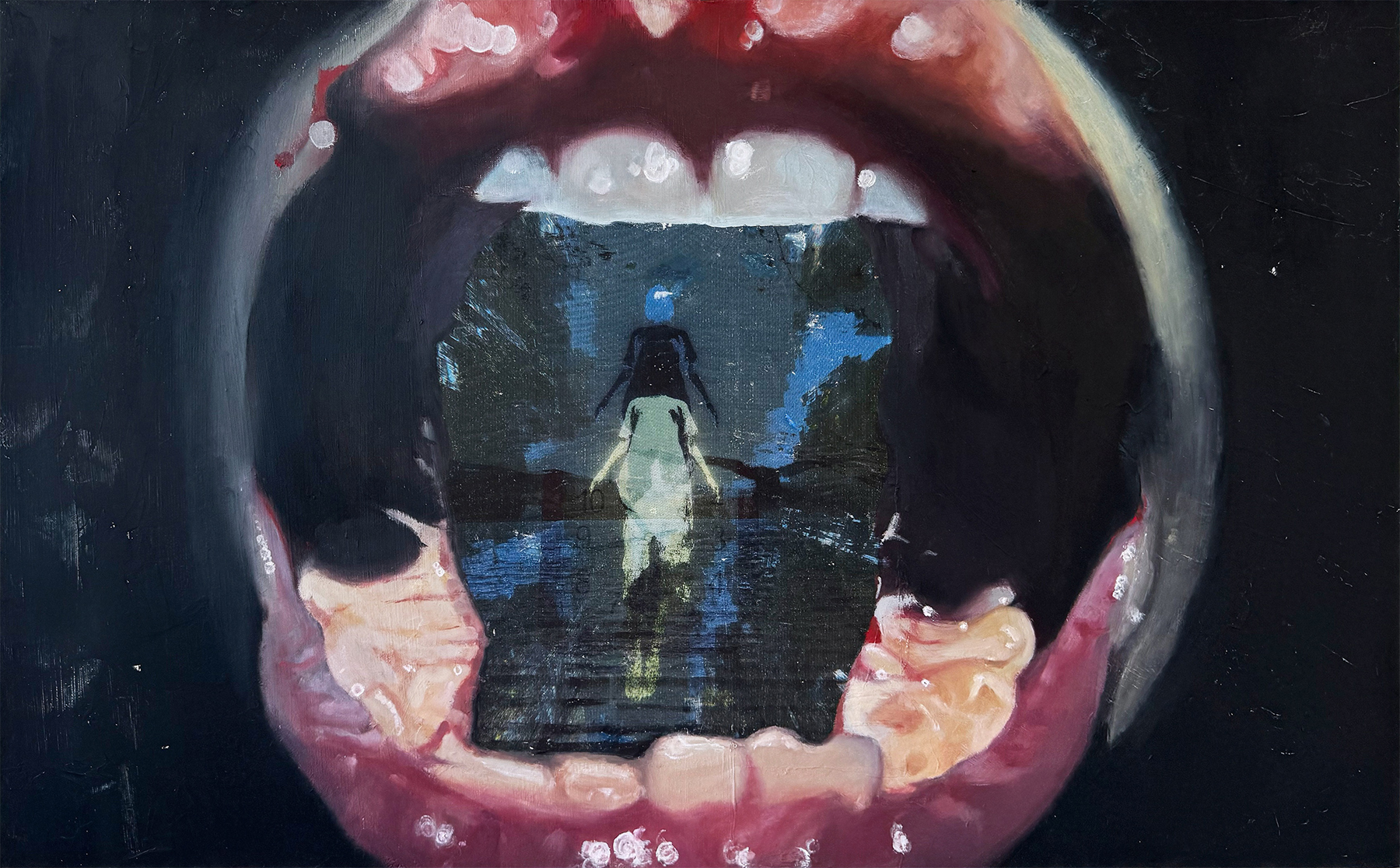
Experimenting with different materials and techniques has always been an important part of my practice. I’ve explored a wide range of mediums, including screen printing, photo transfer, wax, traditional oil painting, etc. For me, materials are not simply tools but an essential part of how I express my ideas. Through experimentation, I’ve gradually learned which materials work best for my practice, often combining three or four different techniques within a single piece. Of course, many experiments don’t turn out as expected, and some materials simply don’t suit my work. But I see these failures as equally valuable. They often lead to unexpected discoveries, and I enjoy finding ways to transform those experiences into something new in my work.
How has your practice changed over time?
My artistic practice has changed significantly over time, both in terms of the themes I explore and the way I approach art making. In the beginning, I was strongly influenced by my family and cultural background, so my work often drew on elements of traditional Chinese culture. However, as my practice developed, I gradually realized that I was more interested in the relationship between the personal and the universal. Rather than starting with grand narratives, I became drawn to smaller, more intimate, and sometimes seemingly insignificant moments, exploring how they might reflect something much larger.
Studying in Glasgow has been a particularly important turning point for me. Before that, my practice moved between different themes without a clear central direction. Over time, I began to recognize what genuinely interested me: uncertainty, incompleteness, and the idea that things do not always need to have a fixed meaning or a definite conclusion. This shift has changed not only what I create, but also how I understand the purpose of my practice. I have become more comfortable with ambiguity and more willing to let questions remain unanswered. In many ways, my artistic journey has been a process of gradually understanding what I truly want to explore and finding my own way of expressing it.
What advice would you give to artists who are just starting out?
I’d say be brave and try as many things as you can. Art is very subjective, so don’t limit yourself or feel like you have to fit into a certain box. Most importantly, don’t forget why you started making art in the first place. I think as you grow as an artist, that question becomes the foundation of everything you do. You don’t need to have all the answers right now, just enjoy the process, keep making work, and experiment as much as possible. Once you’ve built up some experience and a body of work, you can start thinking about things like open calls and exhibitions. And definitely believe in yourself. There will always be failures and negative opinions, but don’t let them discourage you. Art is subjective, and I believe your work will eventually find its own audience.
Find out more about Demi’s work on her website, or connect with her on Instagram.
Leave a Reply