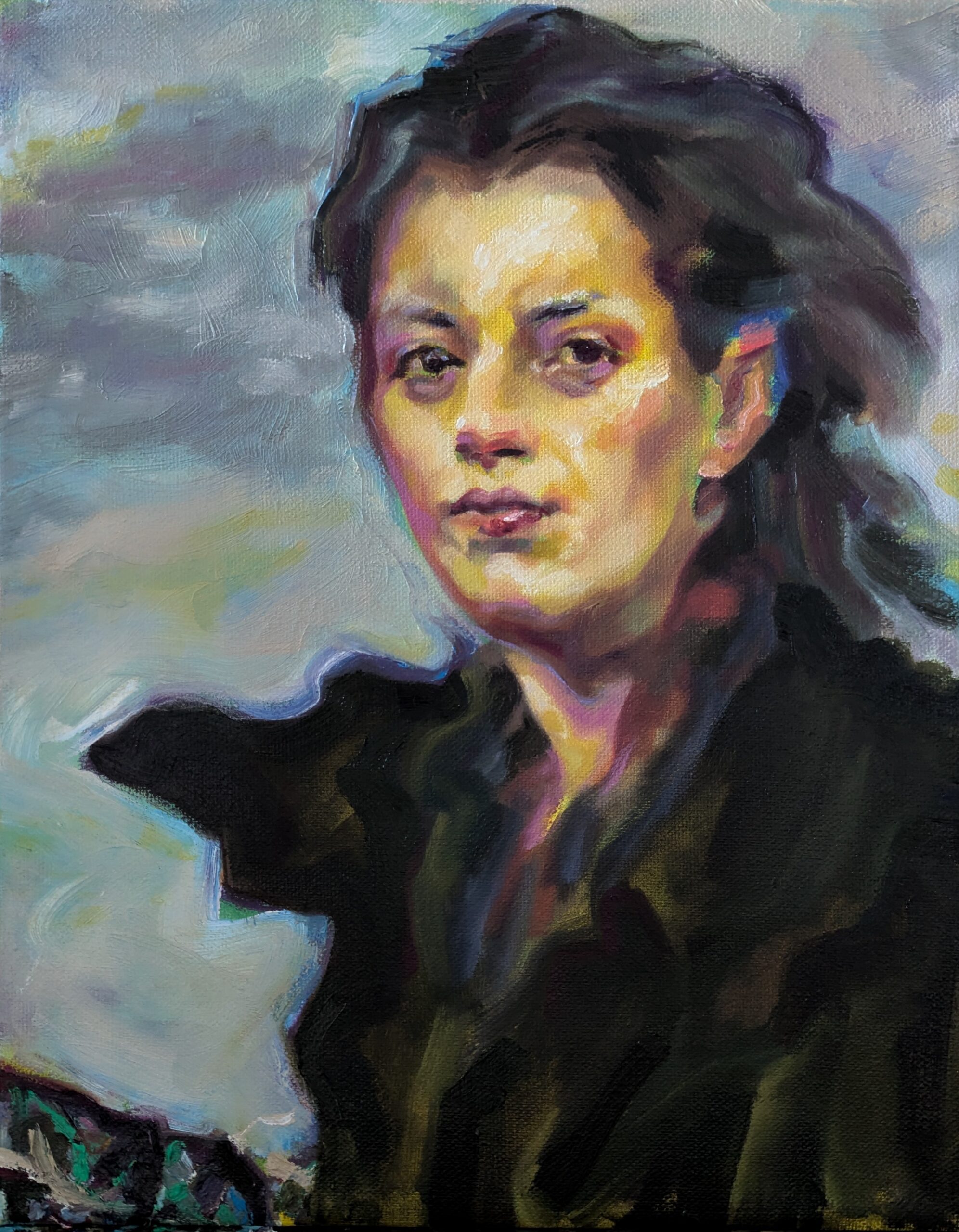
With work focusing on human connection and disconnection, unreality and dreamlike states, Melissa is a portrait painter who studied classical oils and charcoals in Florence and Salisbury. Taking inspiration from the magical held within the mundane, her use of disjointed, often unlifelike colours and the sfumato offered by oils mirrors the blurring of memory and reality. Currently based in Edinburgh, Hugo has exhibited previously with the Society of Women Artists in London, the Royal Birmingham Society of Artists and the Scottish Portrait Awards, winning their Members’ Choice prize in 2022. She is shortly to show with them again at the Scottish National Portrait Gallery, and will appear on series 13 of Sky Portrait Artist of the Year.
See Melissa’s work as part of our annual Autumn open call exhibition, We Fear Nae Evil. Six Foot Gallery is delighted to host thirty three artists exploring the strange and magical stories of Scottish Folklore. Our Sextet listening station is back with twenty-four new pieces for you to spend some quality time with.
Hi Melissa! How did you arrive at the theme of your work?
The theme of the show tickled me immediately! I am hugely interested in folklore, history, horror & spookiness, old wives’ tales and superstitions; this was right up my cup of tea. As a portrait artist, however, I knew I’d want a face to put down. On a personal level I often feel a certain disconnection from ‘reality’, as though I have been spliced in awkwardly – just a beat out of sync – or haven’t yet fully woken from a dream. The Selkie, in her ill-fitting life on land, was a figure I felt I could convey.
How do you overcome creative blocks?
I am not good at this, not in a productive, day-to-day studio way at least. The prevailing wisdom, and I wish I had the knack, is to power through. Keep showing up, keep working, and out of the snarl of yarn that is your brain will rise something inspirational. This just seems to make me feel worse: now I’m blocked *and* flustered about it. Instead I find inspiration can come from anything, the tiniest of things! Music. Reading. A silly conversation or utterly aimless walk. The way the light hits a horrible bus stop, a seagull that seems to laugh specifically at you, a smell that returns you to a childhood memory. You don’t find these things at work, in your curated space, they have to hit you where you go. So I tend to walk. Sometimes half an hour, sometimes a day or two. Walk, look at everything, enjoy, personify, and something will sparkle.
What emotions or reactions do you hope viewers experience when they see your artwork?
The liminal space between the outside world and the subconscious mind fascinates me, as who can ever truly know which is which? Our memories are fallible, our senses easily tricked; every event belongs to us differently. By leaning in to this, I hope for the viewer to inhabit, then question their own certainty of the present moment.
How do you typically approach your creative process?
Initial inspiration is all over the shop! Some come ‘title first’ and work backwards. The smoothest by a long shot come from finding a model & instantly knowing how or where I would want to paint them. Some come first from a woolly & extensive file of snippets; I constantly make note of interesting stories, expressions, thoughts. I photograph a lot. A damp patch of pavement the other day appeared to me like a figure bleeding out of the wall next to it & there’s something in that, somewhere. These can be tricky to solidify though & as I write them on scraps of paper or the edges of bills, they’re pretty disorganised.
My favourite are the images that come in dreams! I do extremely simplified blocking sketches to keep it in my mind. From these initial ideas my route is fairly simple. I don’t favour working from photos & prefer a live model, but you work with what you’ve got and a jumble of reference images are helpful. I find it easy to mentally collage things. Tint the canvas. Usually I go vibrant. I want the underlayer to either shine through or actively be left uncovered in places so it is the vibe of the picture or the colouring of the sitter that decides the tint of the canvas. The initial lay-in is with a broad brush, in a darker variant of the canvas colour. I’m not always as loose as I’d like to be, but any big mistakes made here will haunt the painting all the way through. It is at this point that, with a model, I will ask them to choose what we listen to for a while. Podcasts, music, whatever will get me into their head or their mood of the day. It’s a shortcut to connect, I feel, sharing the moment. I don’t want to sound all “draw the rest of the owl” but from then on it’s really just painting. Make mistakes and don’t ever be afraid to take anything out. No matter how good it is, if an area doesn’t work within the painting: it has to go. I live for the Clunk! This is where I spot a magical Something that excites me. The cogs in my brain clunk in to place, I can see where I’m going, get a sudden burst of energy and work that previously took hours condenses to being almost too fast for me to think about. This does not always happen.
How do you know when a piece is complete?
I tend to be okay at this. Starting with a finished image in mind and not being inclined to overwork things anyway, there’s usually a natural point to call it. Occasionally something will occur to me the day after I’ve officially finished, and I will grumbly, sulkily go back in. It’s always worth it though. Every painting has a final *ding* brushstroke. If these do not happen, your best bet is to flee. Get that picture as far away from you as possible before you ruin it.
Are there any upcoming events or additional information you would like the audience to know?
Last Spring I popped down to London to film my heat for Season 13 of Sky Portrait Artist of the Year, lugging with me a vast caseful of canvases, paints, mediums. I even took my own blue roll in case they supplied a brand I wasn’t used to. Creatures of habit, I suppose, aren’t happy outside their own studio and do not pack light. The show will air from the 7th of October and was quite the experience! After this, in late November, my portrait Grace On Calton Hill will be exhibited at the Scottish National Portrait Gallery with the Scottish Portrait Awards. It’s the inaugural year at such a swanky venue, so very exciting.
Find out more about Melissa’s work on Instagram. We Fear Nae Evil runs at Six Foot Gallery until Friday 16th October.
Leave a Reply