Natalia is a ceramic artist working primarily with porcelain. Originally from Ukraine, Natalia relocated to Edinburgh in 2022 and is rebuilding her creative practice within the Scottish context. Her work explores the balance between fragility and strength, often inspired by natural forms such as leaves, flowers, stones, and organic textures. She is drawn to how porcelain changes through fire, pressure, and time, and how something delicate can become strong and lasting. Themes of displacement, repair, vulnerability, and connection run through much of her work. She often combines porcelain with natural or found elements, allowing materials to speak to one another, letting the contrast in textures, colours, and meanings create a context. She is particularly drawn to imperfection, traces of making, where breaks and joins become part of the story rather than something to hide. Natalia creates both functional and sculptural pieces and is a resident artist at Leith Makers studios, where she continues to develop her practice while building strong connections within the local creative community.
See Natalia’s work as part of our annual Autumn open call exhibition, We Fear Nae Evil. Six Foot Gallery is delighted to host thirty three artists exploring the strange and magical stories of Scottish Folklore. Our Sextet listening station is back with twenty-four new pieces for you to spend some quality time with.
Hi Natalia! How did your artistic journey start?
Well, it all started as a hobby. I began working with clay in 2017, mostly as a way to
reconnect with making things by hand. By 2021 I was a studio member at one of Kyiv’s
ceramic spaces and slowly finding my own style. That same year I discovered porcelain, and
it just clicked. I like to say porcelain chose me, not the other way around. From that moment
I knew I wanted to work only with porcelain, and that’s really where my creative journey
began.
How did you arrive at the theme of your work?
‘Spirit of the Woods’ came from forest walks. Since leaving Ukraine, my family has spent
the past four years in a kind of limbo, and the woods became the one place where I could
really exhale and relax. Nature just keeps flowering from whatever it finds beneath it, and I
found that quietly reassuring. There’s a deeper root too. Living in Scotland as a Ukrainian, I
noticed that both cultures share an old, almost mythical sense of the forest. The land isn’t
passive. It keeps stories, and the line between the seen and the unseen feels a bit thinner there. My work draws on both.
Can you walk us through your creative process?
My work is usually inspired by natural forms like leaves, flowers, stones and organic
textures. I often combine porcelain with natural or found materials such as wood, stone or
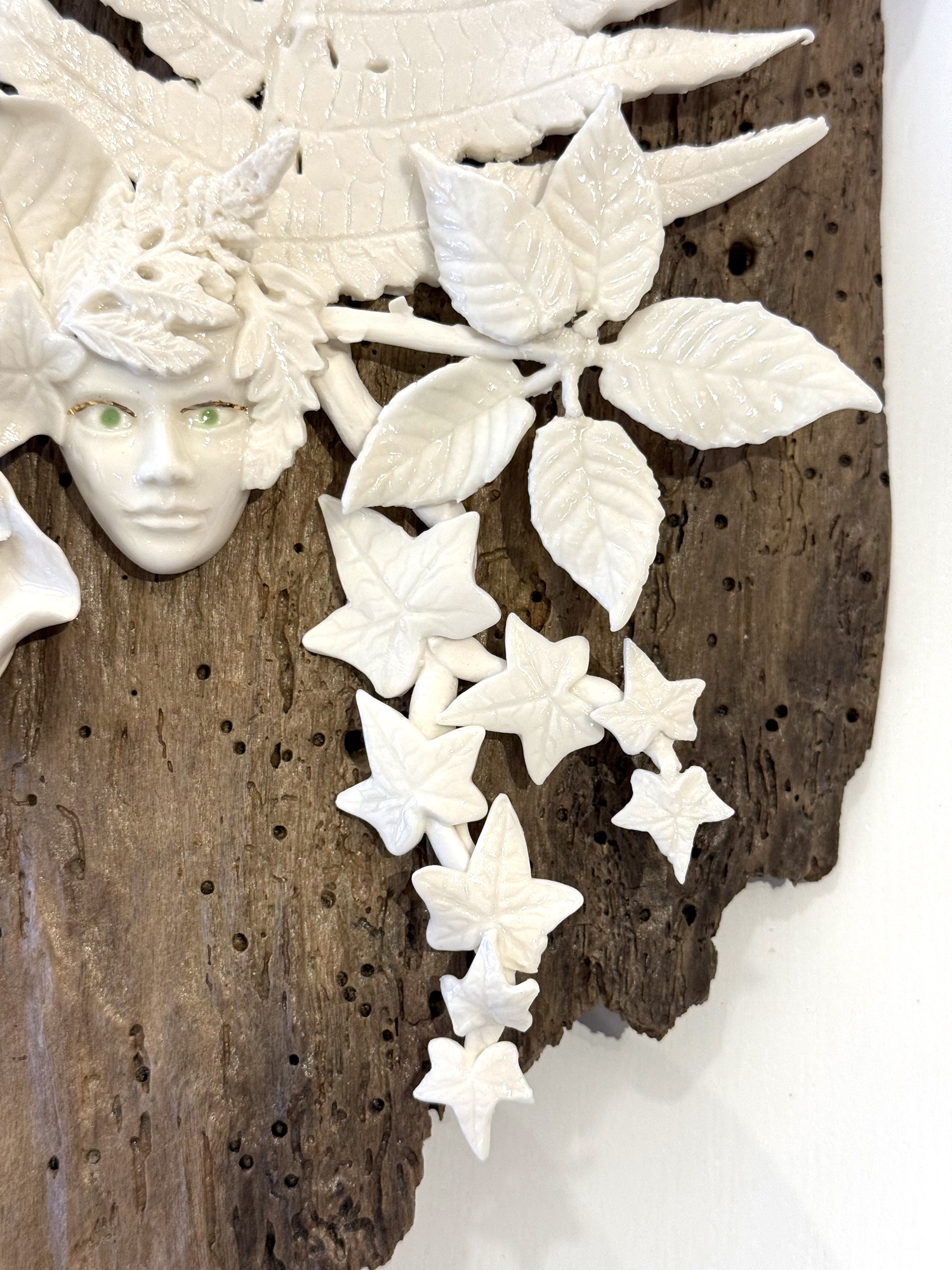
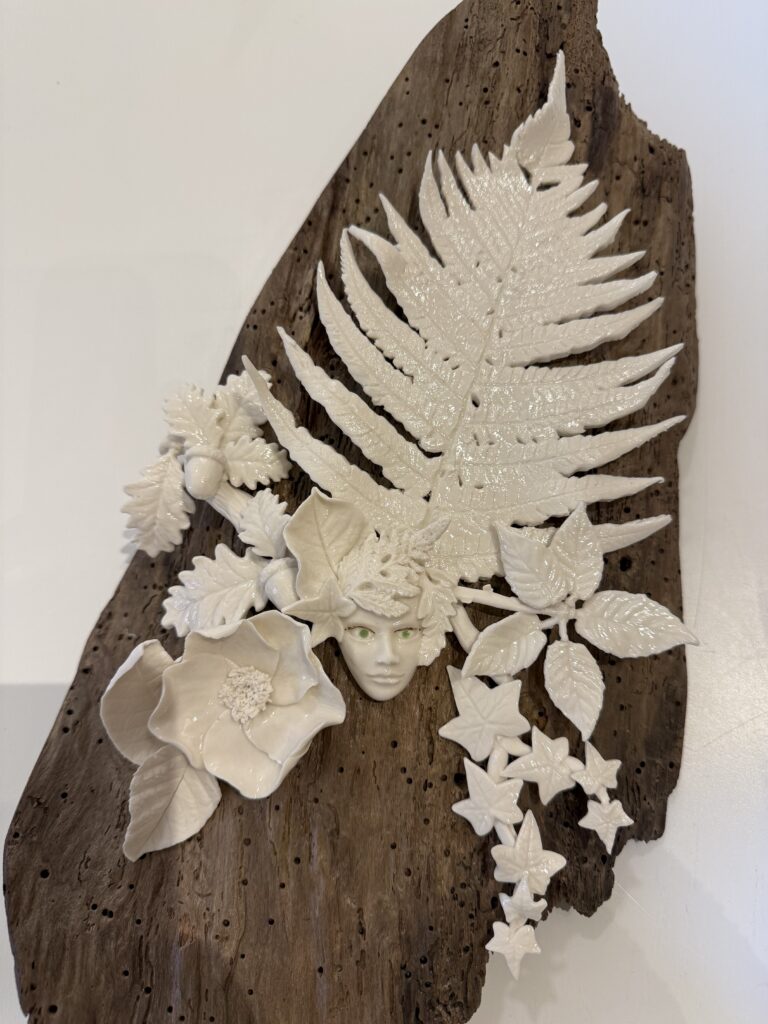
metal, and let them speak to each other. The contrast in texture, colour and meaning creates the context. So my process depends a lot on the found material itself: its shape and surface, where I found it, the mood around it. For example, when I found a certain piece of driftwood, I knew straight away I wanted to set its rough surface against delicate porcelain plants. I wanted them to feel a bit wild, like a spirit that’s half human, half nature, with a little story behind it. In a way it became an offering to a place I love walking in.
Which artists inspire you? Are there non-artistic influences such as literature or music
that impact your work?
I follow a lot of contemporary artists working with porcelain and botanical themes, like Katie
Spragg (UK), Hitomi Hosono (Japan/UK), Sophie Aguilera Lester (Spain) and many others.
But mostly I’m inspired by nature itself: the way plants grow in the woods and flowers bloom in gardens, finding their way out without asking permission, taking root in decay and in the most unexpected places. Watching that, I felt I could do the same, grow and bloom again after leaving everything behind.
Will your next project be a continuation of your current style or are you experimenting
with something different? Can you share a glimpse of your next project?
A bit of both. I’m working on my upcoming solo exhibition, Out of the Bounds, which opens
in spring 2027 in Edinburgh. It’s still botanical, but the experiment is in how I combine
porcelain plants and flowers with different natural materials. In the show, porcelain flowers grow out of hard materials, pushing through stone and breaking past frames as a way of showing inner strength. It’s about blooming despite hard surfaces, despite set frames, despite everything that tries to hold us in place.
Are there specific advantages or challenges associated with working in your chosen
mediums? Have you experimented with other mediums or techniques?
Porcelain is one of the most beautiful materials to work with, and one of the most difficult. It’s fragile and slow. It asks for your full attention and doesn’t allow shortcuts, and that’s exactly what I needed. Working with it keeps me grounded and focused. Flowers are especially tricky and take many hours, with each petal pressed and shaped by hand. I’ve just joined the one-year Contemporary Art Practice course at Leith School of Art, and I’m really was looking forward to it. I think it’ll push my creativity in a good way. I want to move past the caution in my own practice, find more nerve and more joy in putting raw emotion into the work, and let more of myself show through it. It will also allow to experiment with different ideas and mediums. Porcelain and fracture have already given me a language for that. Now I want to see how far I can push it.
Find out more about Natalia’s work on Instagram. We Fear Nae Evil runs at Six Foot Gallery until Friday 16th October.
Leave a Reply