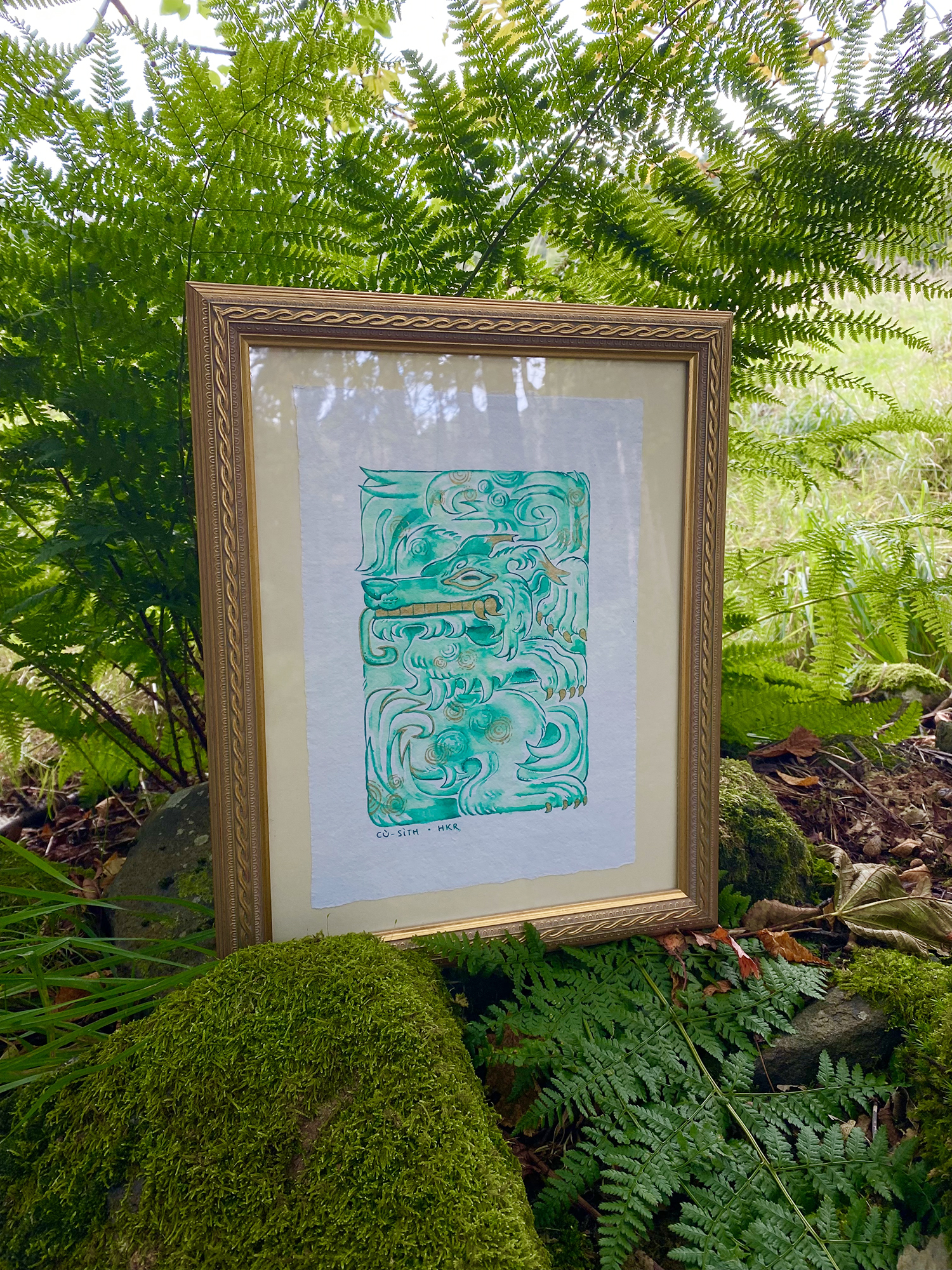
Henri is a non-binary mixed-media illustrator based in the West Lothian area, graduating from Duncan of Jordanstone College of Art and Design. They specialise in exploring the concept of the ‘creature’, and how it has manifested itself in thousands of years of human expression. They use the unpredictability of ink to relinquish perfectionism, creating fine linework which is then destroyed using water. In an age where artwork itself is losing its claim on reality, the humanity of storytelling and the creatures that come with it create their own form through this destruction. Henri’s other means of artistic expression include zine-making, print-making, and writing for comics and short stories.
See Henri’s work as part of our annual Autumn open call exhibition, We Fear Nae Evil. Six Foot Gallery is delighted to host thirty three artists exploring the strange and magical stories of Scottish Folklore. Our Sextet listening station is back with twenty-four new pieces for you to spend some quality time with.
Hi Henri! So how did you arrive at the theme of your work?
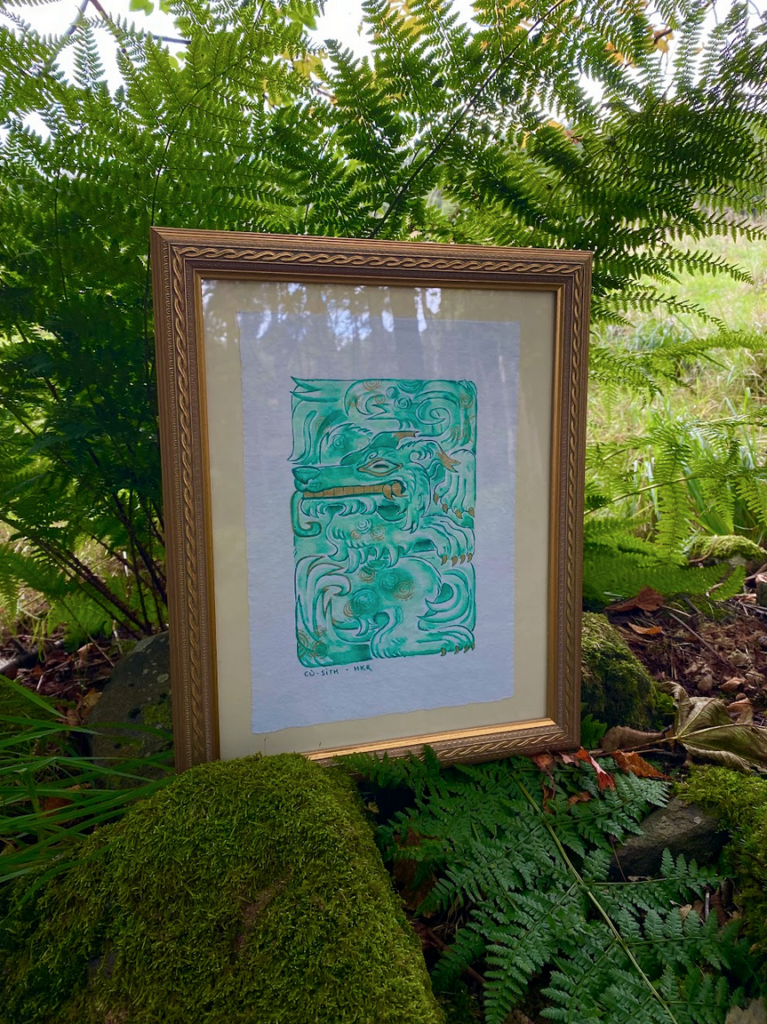
I would describe myself as a folklore and mythology illustrator most of all, but my main subject matter is usually always what I fondly refer to as “the creature”. I am always interested in how ‘the creature’ manifests in storytelling and portrayal of artwork, whether this is historical parietal art (from cave art to geoglyphs) to more recent feats of human expression such as marginalia in literature and the cryptids that are kept alive in campfire tales to this very day. Cù-Sìth, the fairy hound, was the form ‘the creature’ took that day. The unsettling nature of its smile and long toes, and the way it contorts itself into an unnatural shape is how it demanded to be known.
Can you walk us through your creative process?
My process always starts with my sketchbook. I thumbnail in there for hours, and I always know which drawings are the ones I need to develop more. It’s a very instinctual gut feeling, and I continue to draw it again and again until I’m satisfied (enough). I do this with the same fountain pen that I use for sketches and finals. I then scale the final design up, and lightbox it onto textured paper – straight in with fine ink lines again. I cannot express how much detail I put into these lines, they are truly fine and beautiful – and then immediately proceed to destroy the lines with water. My ink is water based, so it disintegrates unpredictably with the water, and this is how I shade and give form. I do have to be careful, because if I am too heavy handed with the water or careless with where my hand is leaning I can bleed the ink too far. Letting go of perfection is invigorating, and in a time where art’s existence is questioned, leaving humanity in artwork is more important than ever. I then gild with gold ink to finish all my pieces, which has become a distinct element of my style.
How has your practice changed over time?
I studied a Bachelors Degree of Illustration at Duncan of Jordanstone College of Art and Design, and the work I graduated with was very different from this piece. I was primarily a digital artist and was hesitant to share my traditionally made sketchbook and development work. Cù-Sìth is made only with water and a fountain pen, which was a completely accidental way of drawing which I refined through keeping a sketchbook. Although I still enjoy creating brightly coloured digital designs for stickers, posters and books, the fine art approach I have taken to portray my creature-themed artwork has renewed my creativity over the last few years, and I am excited to see where else I can take it.
Which artists inspire you? Are there non-artistic influences such as literature or music that impact your work?
The ancient horses and stags smeared from charcoal and ochre dark walls, the anonymous weavers of the Unicorn Tapestries, the spiritual night-and-day unity of Hilda af Klint’s swans, the gilded illustrations in medieval bestiaries: all these inspire me. If there has ever been a visual expression of the non-human, I love it, and I am inspired by it.
What advice would you give to artists who are just starting out?
We need you. Anytime you think it’s hard, or imperfect, remind yourself it is human. Be connected to your creativity: it is what sets us apart from everything else. Human-made art will live forever.
Will your next project be a continuation of your current style or are you experimenting with something different?
Currently I am experimenting with refining my style across other mediums where gilding is common, such as ceramic, which I can’t share yet, but I have plenty of similar A4 sized pieces waiting to be displayed. Cù-Sìth is my debut of this kind of artwork. I also make a weekly zine series on the same kind of paper, scaled down to tiny booklets.
Find out more about Henri’s work on Instagram. We Fear Nae Evil runs at Six Foot Gallery until Friday 16th October.
Leave a Reply