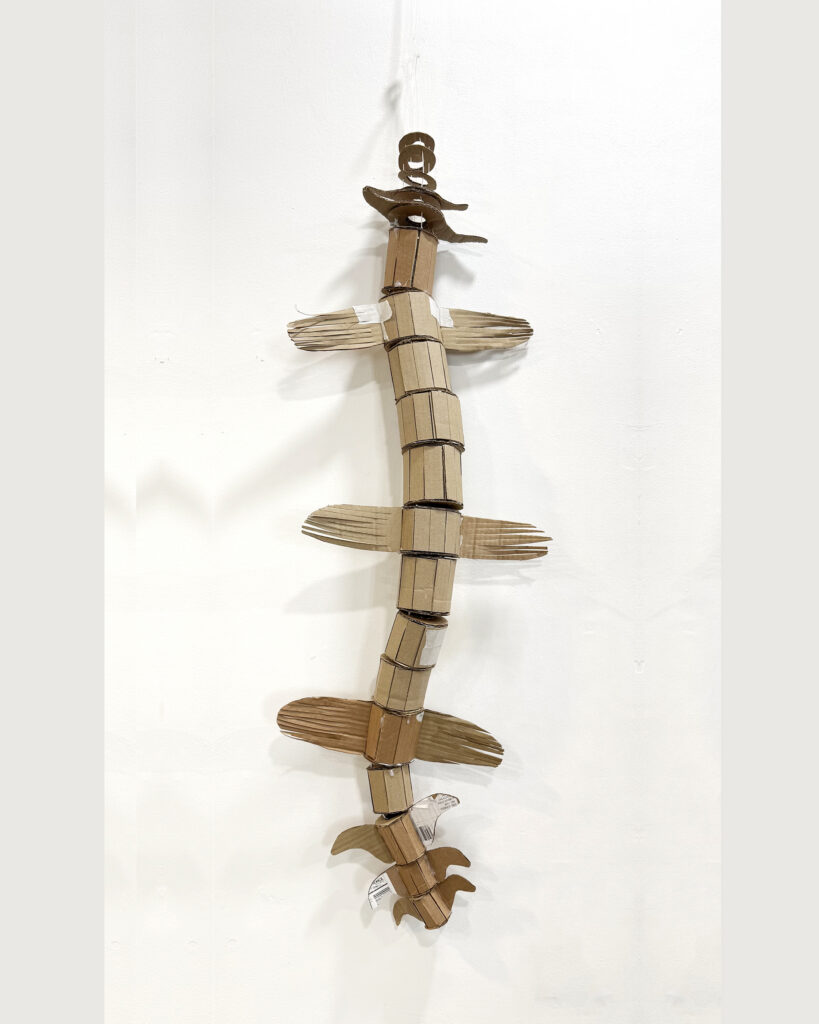
Tori is a Fife-based artist, interested in the remnants of folklore and the ways stories evolve and mutate through retelling over time. Myths are echoes of the past; a way of making sense of the things we cannot fully understand. Tori’s work questions what might be lost through our desire to explain, empirically and physically, that which our ancestors accepted as otherworldly. A graduate of Edinburgh College of Art, Tori works across the mediums of sculpture, painting and mixed media textiles. She is drawn to the abstraction of natural forms, creating objects and images that appear familiar yet remain mysterious. They exist somewhere between the known and the imagined: otherworldly, ethereal, and suggestive of life forms from the deep past, or perhaps of forms yet to evolve. Through this ambiguity, her work explores the space between what we know, what we believe, and what we can allow ourselves to imagine.
See Tori’s work as part of our annual autumn open call, We Fear Nae Evil. featuring thirty three artists exploring the strange and magical stories of Scottish Folklore, plus our Sextet listening station is back with twenty-four new pieces for you to spend some quality time with.
Hi Tori! How did your artistic journey start?
I took a long break from the art world, and worked as an art teacher for over a decade. I loved college, but when I left, the thought of trying to make a career out of my work terrified me – I didn’t have the confidence, or the space. Having studio space was something I totally took for granted at college. I started ‘dabbling’ in my own work again about 6 years ago, but it’s only been very recently since leaving teaching, that I’ve had the energy and headspace to really focus on my own practice. Previously, I found I gave a lot of my creativity energy away to the students. I started noticing all of the colours, texture and forms of fishing equipment piled up around the harbours of the East Neuk. Then I visited the fisheries museum in Anstruther and saw a whale vertebra that got my imagination turning. I’ve always been drawn to the sea, I just want to be in it, so with these things combined I thought, right, this is leading me towards something I need to explore. It’s interesting, because looking back at my college sketchbooks, the themes and ideas I’m interested in now are very similar to back then!
How did you arrive at the theme of your work?
When I was at art college, at the end of second year I was a bit sick of everything including myself, so I went to work on a farm in Corfu. Being in Greece, surrounded by the dramatic landscape and creatures, like goats – which I think have a very mystical air about them – and of course the echoes of all of the Greek mythology, ignited something. I’m talking shrines, temples, talismans, hybrid creatures, gods with specific powers, all interlinked and forming this vast otherworld full of stories of how they all interact with each other. Then I thought, we have all of that here in Scotland too, just in a different way. I watched a film recently called Woodland Dark and Days Bewitched: A History of Folk Horror, and got very excited about it all again!
What emotions or reactions do you hope viewers experience when they see your artwork?
I would like viewers to get that uncanny feeling that what they are seeing is familiar, a memory of it might exist somewhere deep in their subconscious. At the same time though, it’s strange and enigmatic; unsettling. It’s the remnants of something, and I want to invite viewers to fill in the gaps with their imagination. Either from piecing together past experiences or imagining something new entirely. That way, the story of the piece mutates depending on who is viewing it.
Can you walk us through your creative process?
My process has many arms and legs! I need to get everything I’m interested in down in a sketchbook in the form of notes, drawing in location, collage etc, and then go back and start to make links to form ideas. I love continuous line drawing, it stops me from being too self- conscious. I often explore the form of an object by drawing it from lots of different angles using this technique. That mutates it, interprets it into something new. I pick it apart and put it back together again! I love making things, and I’m drawn to creating objects or tactile surfaces. I definitely think in 3D, so I’ll make something, and then draw back from it, add to it, take away from it, make it again using a different material. I know an idea is gaining traction when I’ve got multiple arms of it going at the same time and I’m excited about it. Something I’m finding with my recent work is that it could be shown at various stages. I like the idea of pieces growing and having various stages of life, until it is exhausted and reaches a sort of ‘death’.
Are there specific advantages or challenges associated with working in your chosen mediums? Have you experimented with other mediums or techniques?
I always find scale difficult with my work. I have these ideas, and I really want to make large scale works, but I can’t accommodate that very easily in my studio. I also find colour quite challenging. I like colour, but applying it to the surface of the materials I often use- card and wire, changes the surface qualities of it, and I like the surfaces as they are. I also struggle to be subtle when I work with colour, which doesn’t always suit the themes in my work. It’s definitely something I’m trying to develop in my work. Recently I’ve discovered oil painting, which I’d never tried before. We didn’t get the opportunity to work in oils at my school, and I did sculpture at art college. I’m really enjoying it. I’m following these exercises from a booklet from a Sunday supplement of the Observer that was published in about 2009 that my mum gave to me. I’m starting from scratch and working my way through so that I can appreciate all of its qualities.
Can you elaborate on the significance or symbolism of the chosen title of your
work?
I like the idea that a story can evolve around an object from the imaginations or collective imaginations of those viewing it. I hope the title invites the viewer to speculate on the story of the work without leading them to anything too concrete. Like how myths and folklore evolve, a lot of it depends on who is telling the story and who they are telling it to. The title is to plant the seed of the idea that these are the bones of some creature that exists or existed deep in the ocean in a place uncharted and unexplored. Perhaps the creature is extinct, or is it an evolution of a known life form? The thrill comes from that unknown. I looked this idea up to try to define it better, and I think it’s similar to what John Keats called ‘negative capability’, which means the ability to sit with something ambiguous or uncertain without frantically trying to find a logical explanation.
Find out more about Tori’s’s work on Instagram. We Fear Nae Evil runs at Six Foot Gallery until Friday 16th October.
Leave a Reply