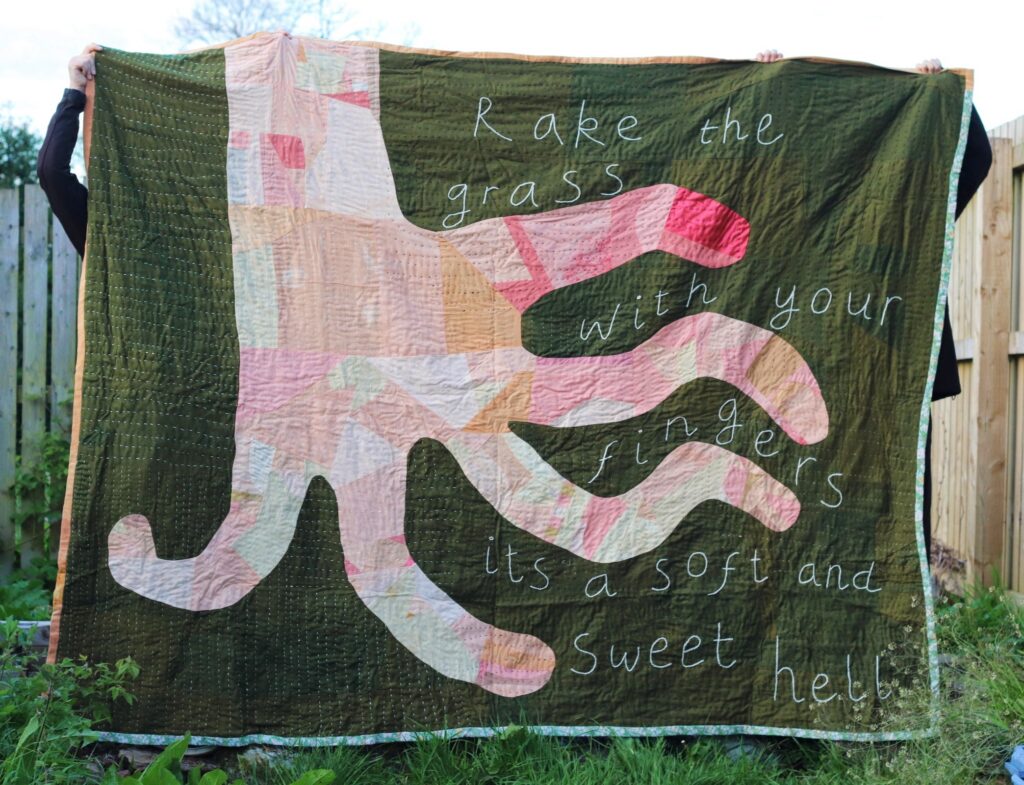
Eilidh Weir is a multidisciplinary artist based on the edge of the Loch Lomond and Trossachs National Park. They graduated from GSA in 2007 in illustration and after years working in design and slow fashion, has found their way back to story telling. Their practice is deeply inspired by gardening and close observation of ecological systems. Composting, soil life, insects and weeds all inform work that explores relationships between people, materials and the natural world. Alongside studio practice, Eilidh facilitates workshops in mending, reuse and textile skills with a wide range of organisations and communities, encouraging more thoughtful relationships with making and materials
Thanks for being with us, Eilidh. Could you tell us how your artistic journey started?
I spent my childhood in my parent’s pottery. Sitting in the back, drawing on boxes of orders that came to stock the shop. Sometimes I’d paint pots, then once they had been fired, sneaking them out onto the shop display when my mum wasn’t looking. She only found out when a customer brought it to the counter to buy. At craft fairs, my dad gave up a precious corner of his stall so I could sell whatever I was making at the time – wonky polished stone jewelry, or hand stitched scrunchies. There were no classes or instructions that I remember, I might have been shown how to be safe with a tool, and then was left to get on with it. I was very fortunate to be given the space to follow my curiosities.
How did you arrive at the theme of your exhibition?
We are living in scary and unpredictable times, and ultimately I want us to survive. I realised that so much of my work – and the way I live – are expressions of love and hope. I make quilts about weeds and insects that depend on them because I want us to change the way we care for green spaces. There are whole lives and communities going on under our noses. I want to celebrate those who are often sprayed with pesticide, or removed to make way for sterile plastic lawns. These wild communities are essential for a future healthy ecosystem, and our survival. In order for them to be valued, they first need to be known. Every interaction and little bit of learning about who is who and who does what fills me with love for the natural world. I want others to know this love too.
I mend clothes because I love my family who wear them, and want to keep their favourites in use. But I also have a deep respect for the many people who I will never meet, who had some hand in growing the fibres, dyeing fabrics, stitching the clothes. All clothes are hand made but so often in exploited conditions. I see my darning of socks or patching of holes as a way of showing respect to the people who worked so hard to make them in the first place.
I create cordage and baskets from waste fabrics and plastics because I don’t want my rubbish ending up in the sea, or piling up in mountains of the minority world’s discarded clothes in Ghana. And I want us to feel the accomplishment of making something with our hands that we might otherwise buy. I want us to break free from the systems of waste. So I show you how I love the world and everyone in it, and I hope you’ll leave and be inspired to mend, save, and fight for better.
How do you overcome creative blocks?
Move on. Go do something else completely different, whether it’s working with a different medium or go work in the garden or read a book. When things get sticky, giving myself some space from the problem helps process solutions, or at least find another angle to approach it from.
What emotions or reactions do you hope viewers experience when they see your artwork?
My biggest hope is that my work encourages people to pause and reconsider what is actually waste. We used to be so resourceful, we used materials around us to make all sorts of things. Over time, we lost skills and knowledge as conveniences trickled in – for a price. Now everything we wear, use and eat needs to be bought. Not only that, but the list of companies who will sell us what we need shrinks smaller every year. We lost the skill, we pay for the product and we make some people very very rich, while they tell us what to buy next.
It’s a mammoth task to push back against 200 years of capitalism, but if I inspire people to be curious about waste, and weeds and learn to darn a sock I will be very happy.
Are there specific advantages or challenges associated with working in your chosen mediums? Have you experimented with other mediums or techniques?
The challenge I now have is that I can see potential usefulness in so much around me. I collect more materials than I can use and find it quite hard to bin things. Chopping back some plants in the garden – I could weave with that! About to throw away some colourful plastic bags at work – that could be cordage! Any single scrap of fabric no matter how small that passes through my home – I’d better keep that for a quilt! It helps that I teach workshops so some can be used then, however it only fuels my justification for keeping things.
My family is very patient with me. Because despite having a designated studio, my work (and the collecting of materials) spills into my home. It’s summer, so we are in the season of plants being draped on every surface to dry.
Are there any upcoming events or additional information you would like the audience to know?
Yes! I have a load of workshops coming up over the next few months where people can learn some of the techniques I use, from cordage making, to visible mending and quilting. I LOVE sharing these skills with people and sitting round the table together chatting. Go see the full listings at https://allthatisbraw.bigcartel.com/events
Find out more about Eilidh’s work on Instagram or their website. Eilidh’s solo show, Show Me How You Love, runs at Six Foot Gallery until Friday 24th July 2026.
Leave a Reply