Amy Iona is a lens-based artist, researcher and creative facilitator. She graduated from Edinburgh College of Art in 2020 and was latterly awarded the inaugural Creativity, Inclusivity & theVirtual award to support a year of research at the University of Glasgow, developing frameworks for access and inclusion in thecreative industries. She is interested in facilitating encounters with art outwith the white cube, and contributing to projects which foster collaboration and collective care. Amy is particularly interested in how relationships between people and nature are impacted by social and cultural identity, explored through photographic objects and alternative processes. Her work is heavily informed by Scottish folklore, esotericismand queer feminist theory.
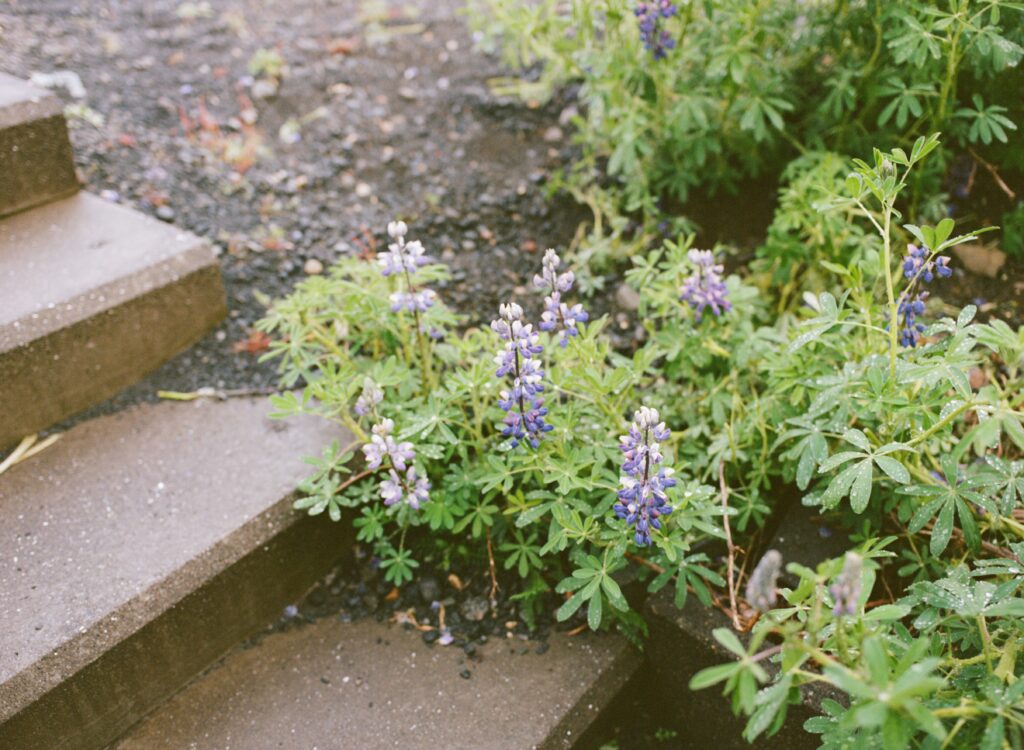
See Amy’s work as part of our annual spring exhibition Offerings, exploring the ways that hope and creativity can take root in hostile environments. Inspired by queer histories of creating against all odds, and by the ways communities nurture possibility and make offerings for the future, Offerings showcases works that bring warmth, colour, and a sense of renewal, that soften the spaces they inhabit, or that suggest endurance or growth: no matter how harsh the winter, the flowers will bloom again.
Hi Amy! Tell us, how did your artistic journey start?
I use analogue and alternative processes to explore how connections to nature are impacted by social and cultural identity, especially as someone living and working in a built-up city environment. I’ve always been really concerned with connections to place, community heritage and mythology, but it took me a long time to understand the legitimacy of that kind of folk knowledge in contemporary art practice. It also took me a long time to break into arts education, which has given me a little touch of middle child syndrome. Now there’s much better recognition and support for artists without a “formal” education from an institution, but ten years ago it was supposedly “the right thing” to keep pushing into systems that weren’t always supportive or accessible. A huge part of my artistic journey has been to unlearn what I learned in art school, which is not uncommon, so I’ve become a huge advocate for alternative education and peer support networks. During the pandemic, I was forced to step back from my practice, and had a great experience pursuing more curatorial and research-led roles. Now I’m able to combine that research experience with reconnecting to a material practice, but I try to look beyond “the art world” as much as possible. I’ve volunteered with a couple of community gardens, for example, and found that this kind of engagement has naturally guided my work in a more mindful and co-creative direction.
What challenges did you experience during the creation of your work and how did you
overcome them?
In general, being diagnosed with a neurodevelopmental disorder has blown my sense of self
wide open, and by extension has completely transformed the way I approach creating work.
Neurodivergency has a contradictory impact on my practice; working with communities is the main driver behind my work, but I can often only sustain my practice at home or in isolation. Having fought to gain access to arts education in a pre-diagnosed state, I threw myself into organising community events and crit sessions, which I now recognise as attempts at creating peer support. This was long before understanding my own need for better cognitive access and the space to unmask. Eventually I ended up with a research scholarship from the University of Glasgow, and used it to co-develop inclusive strategies for participation in the arts sector. It’s an ongoing process to accept the way my brain functions without fully surrendering to exhaustion or a state of learned helplessness. What keeps me showing up is an unflinching belief in the value of neurodivergent and disabled ways of working.
Will your next project be a continuation of your current style or are you experimenting
with something different? Can you share a glimpse of your next project?
Here’s another neurodivergent contradiction! I really value sustained research and methodical, practice-led ways of working, but my brain needs urgency and novelty to function. Again, it’s a delicate balance of allowing ideas to develop whilst following lots of different simultaneous threads. My piece in Offerings is part of a wider project which began as a way to process a huge personal loss, and has turned into a reflection on how connections between the living and the dead are affected by culture, ritual and collective memory. I’m holding off debuting or even teasing the work on social media – I really want to give this one space to grow and develop organically without it dropping off the vine. The intention is to debut it physically and create a space for collective healing. In the meantime you can probably spot me foraging, gathering, gardening and photographing around Glasgow – I can never stay still for too long.
What advice would you give to artists who are just starting out?
From the Working Class Creatives manifesto: take up space, but leave room for others.
Adaptable systems benefit everybody, and accessible spaces are worth advocating for. Periods of rest are as critical to creative practice as bursts of productivity. Learn a trade or a practical skill but digital literacy is also empowering: document everything, and back it up!
Are there any upcoming events or additional information you would like the audience to
know?
Glitra, a duo exhibition, opens at SaltSpace Gallery on the 24th of April. I met fellow artist
Jacqueline Wray through SaltSpace, totally by chance, and we bonded over our love of nature and an intuitive approach to making work. Glitra is for the dreamers and lovers of folklore and mysticism – it’s a free exhibition and all are very welcome! Full details can be found on my Instagram.
OFFERINGS runs at Six Foot Gallery until 21st April 2026. Connect with Amy on Instagram, or on her website.
Leave a Reply